 7 OCT 2026
26/11 Mumbai Attacks
Holy Land Foundation convicted of funding Hamas – Muslim Brotherhood ‘Explanatory Memorandum’ in evidence
On 24 November 2008 a federal jury in Dallas convicted the Holy Land Foundation for Relief and Development, once the largest Muslim charity in the United States, and five of its leaders of providing material support to Hamas, a designated foreign terrorist organisation. The US Justice Department said the defendants had provided approximately $12.4 million to Hamas. In May 2009 the court imposed sentences of between 15 and 65 years.
Among the prosecution's evidence was an internal Muslim Brotherhood document, Government Exhibit 003-0085: "An Explanatory Memorandum on the General Strategic Goal for the Group in North America", dated 22 May 1991. The George Washington University Program on Extremism describes it as "an 18-page internal memorandum sent by Mohammed Akram, a member of the Shura Council of the U.S. Brotherhood, to the rest of the Shura Council in 1991". It was among the Brotherhood archives the FBI found in 2004 in a hidden sub-basement of the Annandale, Virginia home of Ismail Elbarasse.
In the court's English translation, the memorandum states: "The Ikhwan [Muslim Brotherhood] must understand that their work in America is a kind of grand jihad in eliminating and destroying the Western civilization from within and 'sabotaging' its miserable house by their hands and the hands of the believers so that it is eliminated and God's religion is made victorious over all other religions." It gives the group's strategic goal as the "enablement of Islam in North America" and attaches "a list of our organizations and the organizations of our friends".
According to the GWU report, Akram later served as secretary general of the International al-Quds Foundation, a Lebanon-based institution headed by Yusuf al-Qaradawi.
More sources:
- justice.gov - Federal jury in Dallas convicts Holy Land Foundation and its leaders (24 Nov 2008)
- justice.gov - Sentences handed down (May 2009)
- fbi.gov - Holy Land Foundation convictions
- GWU Program on Extremism - The Muslim Brotherhood in America (Lorenzo Vidino, July 2025)
- Explanatory Memorandum - scan of Government Exhibit 003-0085 with court translation (Center for Security Policy archive copy)
Introduction
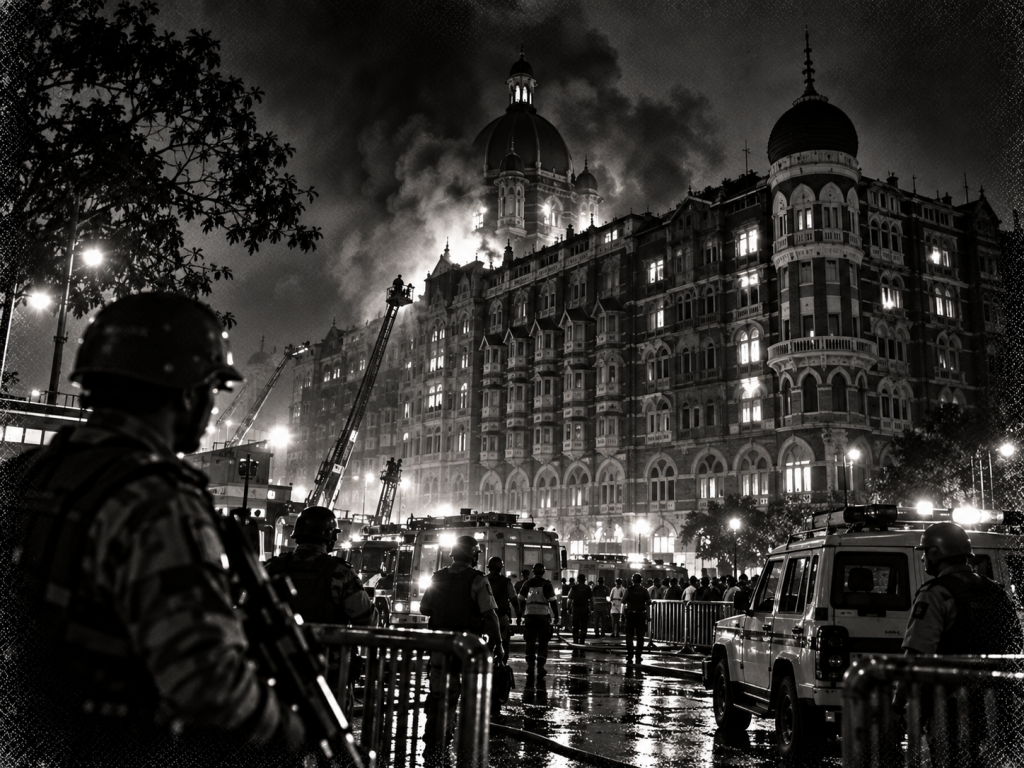
On the night of 26 November 2008, ten men came ashore in Mumbai and attacked several sites across the city at once: the Chhatrapati Shivaji Terminus, the Taj Mahal Palace Hotel, the Oberoi Trident, Nariman House, Leopold Cafe and Cama Hospital. The siege lasted into 29 November.
One hundred and sixty-six people were killed, including six United States citizens, and hundreds were wounded. Nine of the ten attackers were killed. The tenth, Mohammed Ajmal Amir Kasab, was taken alive.
Kasab told Indian police, and later the FBI, that he was Pakistani and a member of Lashkar-e-Taiba, and that the attack was being directed in real time from Karachi. That account became the backbone of the Indian case.
Government Response
India
The National Security Guard ended the sieges at the hotels and at Nariman House. Kasab was tried in Mumbai, convicted, and hanged at Yerwada Central Jail on 21 November 2012. He is the only one of the ten to have stood trial in India.
India named Lashkar-e-Taiba commanders, among them Zaki-ur-Rehman Lakhvi and Hafiz Saeed, as well as an Inter-Services Intelligence officer referred to in American court papers as Major Iqbal. Pakistan detained some men and opened a trial that did not reach the people India most wanted. On the Indian account, Lakhvi, Saeed, Sajid Mir and Major Iqbal remained beyond reach.
The American who scouted the city
David Coleman Headley, a United States citizen born Daood Gilani, reconnoitred the targets. He was arrested in October 2009 on a separate plot against Denmark, pleaded guilty in Chicago to his part in Mumbai, and was sentenced to 35 years. Under the plea he cannot be extradited to India. His Chicago evidence put an ISI officer on a United States indictment for the murders of the six Americans. That officer has not been produced. His associate Tahawwur Rana was extradited from the United States to India on 9 April 2025 and is before a court in Delhi.
ProPublica later reported that Headley's wife had warned American officials three times in 2007 and 2008 that he was a terrorist on missions in Mumbai. A CIA channel to India, described in later books and reporting, had also flagged a fidayeen-style assault. Even so, the agencies did not stop the ten men reaching the shore.
Australia
Two Australians were among the dead: Douglas Markell of Woollahra and Brett Taylor of Turramurra. On the first anniversary, both sides of the Australian Parliament made statements in the House and the Senate condemning the attacks.
Summary
Ten men attacked Mumbai over three days and 166 people died. Nine of the attackers were killed and one was hanged in Pune. The man who scouted the targets beforehand is in an American prison and cannot be sent to India, and the commanders India named have not stood trial in an Indian court. The warnings that later came to light did not stop the boats.
Kasab's judgment and Headley's Chicago sentence are both public documents.
You be the judge.