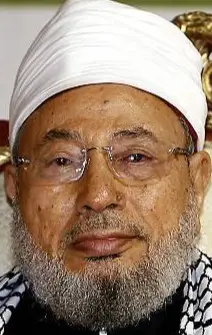
Yousef Al Qaradawi
also known as Yusuf al-Qaradawi
Egyptian Islamic theologian, global spiritual leader of the Muslim Brotherhood, and founder/former head of the International Union of Muslim Scholars (IUMS). · 1926 – 2022 · Egypt/Qatar
2008 – 2018 · 6 moments
2008Refused a UK visaMarch 2012Barred from FranceApril 2013Meets Australia's Grand Mufti in DohaClick to read →June 2013Urges Sunnis to fight in SyriaClick to read →2014Interpol Red Notice at Egypt's requestClick to read →2018Steps down as IUMS president200820102012201420162018In AustraliaOverseas
April 2013
Meets Australia's Grand Mufti in Doha
Reported by The Australian.
June 2013
Urges Sunnis to fight in Syria
"Everyone who has the ability and has training to kill... is required to go."
2014
Interpol Red Notice at Egypt's request
Removed in 2017.
Primary Role
Egyptian Islamic theologian, global spiritual leader of the Muslim Brotherhood, and founder/former head of the International Union of Muslim Scholars (IUMS).
Affiliations
Connections
- Ideological stance: promoted wasatiyyah (often translated as "moderation"). He also publicly endorsed suicide bombings against Israelis. In a 2004 BBC Newsnight interview he said: "I supported martyrdom operations, and I am not the only one." (Times of Israel, 26 September 2022)
- Ibrahim Abu Mohamed — met him in Doha, 2013; IUMS trusteedocumented
- Shady Alsuleiman — praised him as a formative influencedocumented
Documents & Video
- * Hosted Al Jazeera's long-running weekly program Sharia and Life, which made him one of the best-known clerics in the Arab world.
- * Syria, June 2013: in a Friday sermon and rally in Doha he urged Sunni Muslims to fight the Assad government and its allies Hezbollah and Iran, saying "Everyone who has the ability and has training to kill … is required to go." He called Assad's Alawite sect "more infidel than Christians and Jews". Saudi Arabia's Grand Mufti praised his stance on Hezbollah. (Egypt Independent / AFP, Al Arabiya, June 2013)
- * Australian link: in April 2013 Australia's Grand Mufti, Ibrahim Abu Mohamed, met him in Doha (The Australian, 16 December 2015).
- * Entry bans: refused a UK visa in 2008. The UK Home Office said: "The UK will not tolerate the presence of those who seek to justify any acts of terrorist violence or express views that could foster inter-community violence." (Al Jazeera, 7 February 2008). In March 2012, after the Toulouse shootings, President Nicolas Sarkozy announced he would be barred from entering France (France 24).
- * Interpol: a Red Notice was issued in 2014 at Egypt's request, accusing him of inciting violence. Interpol removed him from its wanted list in 2017 (Al Jazeera, 10 September 2017).
Controversial Matters Involving Sheikh Dr Yusuf al-Qaradawi
The following matters are arranged from the most serious public controversies to lesser but still significant controversies. The order considers the scale of actual or potential loss of life connected to each matter, as well as Qaradawi’s proximity to the controversy. This is not a finding that he personally caused each outcome.
Highest-Severity Controversies
| Order | Date | Matter | Location | Summary | Why It Was Controversial |
|---|---|---|---|---|---|
| 1 | 2013 | Call for jihad against Assad | Syria / Qatar | Qaradawi called for jihad against the Syrian government after Hezbollah entered the Syrian war. | Syria’s war had mass-casualty scale, and critics argued the call risked mobilising foreign fighters into an already catastrophic conflict. |
| 2 | 2000s (reversed 2016) | Approval of Palestinian “martyrdom operations” | Israel / Palestinian territories | Qaradawi defended suicide attacks in the Israeli-Palestinian conflict under certain conditions from the mid-1990s, formalised in a 2001 fatwa. In 2016 he publicly reversed the position, stating he no longer considered such operations permitted. | The controversy centred on religious justification for attacks that killed civilians. His later reversal is part of the record and should not be omitted. |
| 3 | 2005 | Suicide attacks in Iraq | Iraq | He was reported as saying suicide attacks against US forces in Iraq were a duty. | Iraq was already in a lethal insurgency; critics said the statement legitimised suicide violence in a war zone. |
| 4 | 2025 | IUMS armed-jihad fatwa against Israel | Qatar / Israel-Gaza context | The International Union of Muslim Scholars, an organisation Qaradawi founded and long chaired, was linked to a later armed-jihad fatwa. | This occurred after Qaradawi’s death, so it is an institutional legacy issue rather than a personal act. Critics argued it risked wider mobilisation. |
| 5 | 2011 | Fatwa endorsing the killing of Muammar Gaddafi | Libya | During the Libyan uprising, Qaradawi issued a fatwa stating that any Libyan soldier who could shoot and kill Gaddafi should do so, justifying it on the basis of Gaddafi’s “mass murders and heinous crimes.” | This was an explicit religious endorsement of killing a sitting head of state, not a general expression of support for the uprising — an actionable cause, not just rhetoric. |
| 6 | 2009 | Remarks about Hitler and Jews | Al Jazeera / Qatar | Qaradawi was reported to have described Hitler as divine punishment against Jews. | The remarks were widely criticised as antisemitic and inflammatory — rhetoric rather than a call to a specific violent act. |
Major Political and Security Controversies
| 7 | 2013 | Fatwa calling for martyrdom against Egypt’s post-coup government | Egypt / Qatar | After Morsi’s removal, Qaradawi declared it “haram,” warned of “divine wrath and punishment,” and issued a fatwa calling on Muslims worldwide to become martyrs in Egypt — reported as effectively a call for jihad. He also branded participants in the anti-Morsi uprising “khawarij,” a term historically used to excommunicate a group from Islam. | This went beyond denouncing the coup: it was a martyrdom/jihad call and religious excommunication-adjacent language directed at fellow Muslims, which is why an Interpol warrant (incitement, arson, vandalism, theft) followed. |
| 8 | 2013-2018 | Interpol Red Notice requested by Egypt | Egypt / Qatar | Egypt sought international action against Qaradawi over alleged offences including incitement and violence-related claims. | Interpol later removed him from its wanted list, with supporters saying the case was politically motivated. |
| 9 | 2004-2018 | Leadership of International Union of Muslim Scholars | Qatar / transnational | Qaradawi co-founded and chaired the IUMS for many years. | The organisation became controversial for political religious rulings and its role in regional conflicts. |
| 10 | Repeated | Support for Hamas as resistance | Gaza / Qatar | Qaradawi publicly supported Hamas and framed its actions as resistance. | Critics argued this legitimised a group responsible for attacks on civilians; supporters framed it as anti-occupation resistance. |
Government Bans and Public-Order Disputes
| 11 | 2008 | UK entry refused | United Kingdom | The UK refused him a visa. | The Home Office said the UK would not tolerate people who justify terrorist violence or express views that could foster inter-community violence. |
| 12 | 2012 | France barred entry | France | France said Qaradawi was not welcome after a domestic security crackdown. | French officials said certain preachers called for hate and violence and posed public-order risks. |
| 13 | 2000s | Apostasy punishment rulings | Transnational | Qaradawi’s views on apostasy punishment attracted criticism from human-rights advocates. | The issue is serious because apostasy laws can carry lethal punishment in some jurisdictions. |
| 14 | 2000s | Arguments concerning Israeli civilians | Israel / Palestinian territories | He made arguments that critics interpreted as permitting civilian deaths in some attack contexts. | The controversy was over normalising civilian targeting under religious or military necessity arguments. |
| 15 | 2000s | Statements on Jews and Jerusalem | Middle East / broadcasts | Qaradawi made repeated statements about Jews, Israel and Jerusalem that drew international criticism. | Critics argued the language was antisemitic and escalatory. |
Additional Controversies
| 16 | 2004 | London visit controversy | United Kingdom | His visit to London became a political controversy involving then-Mayor Ken Livingstone. | The dispute centred on whether Qaradawi was a reformist scholar or an extremist preacher. |
| 17 | 1990s-2000s | US exclusion controversy | United States | Qaradawi was reportedly unable to enter the United States for many years. | The issue centred on extremist speech and terrorism-related concerns. |
| 18 | Ambivalent pre-2006; opposed from 2006 | Female circumcision / FGM position | Religious rulings | Previously ambivalent on the issue; at a November 2006 international conference Qaradawi explicitly joined the anti-FGM position, stating it constitutes “changing God’s creation” and declaring “we are on the side of those who ban this practice.” | His earlier, more permissive framing drew criticism from FGM opponents; his 2006 reversal is part of the record and should be included alongside it. |
| 19 | 2000s | Homosexuality rulings | Transnational | His rulings on homosexuality were criticised by human-rights advocates. | The potential severity depends on whether such rulings are used by states or militants to justify punishment. |
| 20 | 2000s-2010s | Sectarian anti-Shia rhetoric | Gulf / Syria | His rhetoric became more controversial as Syria’s war deepened. | Critics argued sectarian framing could feed mass violence. |
| 21 | 2011-2013 | Arab Spring political preaching | Egypt, Libya, Syria, Qatar | Qaradawi supported several Arab Spring uprisings. | Supporters saw pro-democracy activism; critics saw clerical mobilisation during unstable revolutions. |
| 22 | Long-running | Muslim Brotherhood association | Egypt / Qatar / global | He was widely described as a spiritual guide or major influence for the Muslim Brotherhood. | The controversy stems from the Brotherhood’s banned or terrorist status in some countries and legal political status in others. |
| 23 | Long-running | Al Jazeera platform and mass influence | Qatar / global | His television platform gave him enormous reach across the Arabic-speaking world. | The scale of broadcast influence made his statements security-relevant to governments and critics. |