 7 OCT 2026
Glasgow Airport Attack – Scotland
7 OCT 2026 Death DVDs – Sheikh Feiz Mohammed
In January 2007, reports said Sheikh Feiz Mohammed, head of the Global Islamic Youth Centre in Liverpool in Sydney's west, appeared in a set of DVD lectures called the "Death Series". In the lectures he urged children towards martyrdom and called Jewish people pigs. The SMH reported that the DVDs had been "exposed this week in the British documentary, Undercover Mosque". It also said British investigators found them being sold by children in the car park of the Green Lane Mosque in Birmingham. The SMH said he was Sydney-born and had spent the past year living in Lebanon.
The SMH quoted the DVD: "Teach them this: that there is nothing more beloved to me than wanting to die as a Mujahid." The ABC reported: "The Australian Federal Police (AFP) is investigating the DVD." Acting federal Attorney-General Kevin Andrews said: "The importation of hatred into Australia is totally unacceptable." NSW Premier Morris Iemma said: "The sort of incitement that the DVD encourages is incitement to acts of violence and acts of terror."
In April 2007 the ABC reported that the Office of Film and Literature Classification had given the DVDs a PG rating. Acting NSW Premier John Watkins said: "I'm disgusted that any film calling for martyrdom and murder and describing anyone from any religion as a pig could be determined suitable for our children."
More sources:
Introduction
What happened
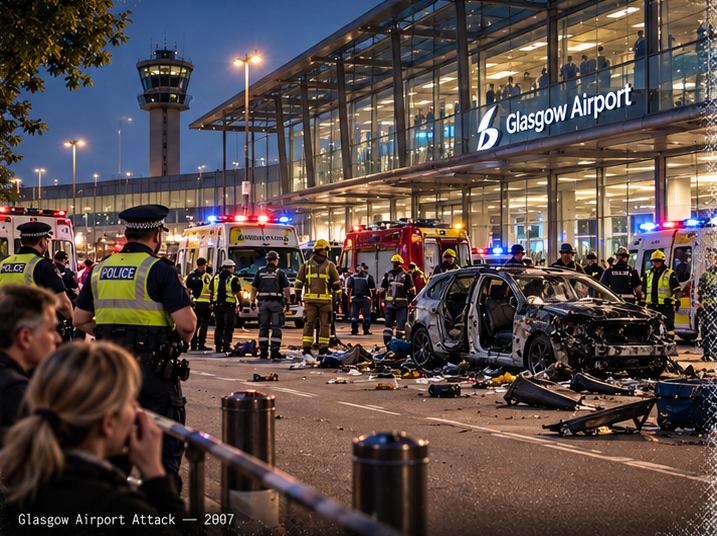
On Saturday 30 June 2007, a Jeep loaded with gas cylinders and petrol was driven into the main terminal of Glasgow Airport. The Home Secretary told Parliament: "At 3.15 pm on 30 June, a Jeep Cherokee drove into a front door at the check-in area of the terminal building at Glasgow airport and caught fire on impact." She said one member of the public was slightly injured in the immediate aftermath.
About 4,000 people were inside the terminal. A concrete pillar at the main door stopped the Jeep from getting into the departure hall.
The two men in the Jeep were Bilal Abdulla and Kafeel Ahmed. When the Jeep failed to explode, Abdulla threw petrol bombs and Ahmed doused himself in petrol and set it alight. Police officers and members of the public subdued the men. Ahmed suffered burns to 90% of his body and died in Glasgow Royal Infirmary on 2 August 2007.
The London car bombs
In the early hours of 29 June, two Mercedes cars containing petrol, gas cylinders and nails were found in Haymarket and Cockspur Street in central London. Explosives officers made both safe. The Home Secretary told the Commons: "Police have confirmed that the incident at the airport was linked to the vehicles discovered in London".
At sentencing, the judge said of the London attacks: "Your murderous intent was best shown by the obstructing of the safety mechanisms on two of the cylinders and by the 800-plus nails in one car and 1,000 in the second, designed to do nothing else but constitute a deadly form of shrapnel to maim, injure and kill".
The Australian connection
Dr Mohamed Haneef, a second cousin of Kafeel Ahmed, was detained in Australia on 2 July 2007. The case against him collapsed and the charges were dropped. An independent inquiry later found no evidence linking him to the London and Glasgow attacks.
Government Response
The United Kingdom
The Joint Terrorism Analysis Centre raised the UK national threat level from severe to critical on 30 June. Ministers held four meetings of the Cobra emergency committee. Police stepped up high-visibility patrols, including armed response vehicles, and stop-and-search, and there was "increased physical protection around airport terminal buildings, including tighter controls on access roads and the installation of new barriers".
Prime Minister Gordon Brown said: "The first duty of the government is the security and safety of all the British people, so it is right to raise the level of security at airports and in crowded places in the light of the heightened threat".
All flights at Glasgow Airport were suspended. By 5 July the threat level had been lowered back to severe.
Brown ordered a review of NHS recruitment, led by the new terrorism minister, Sir Alan West. He also announced expanded background checks on skilled migrant workers and a review of whether intercept evidence could be used in court.
The prosecutions
On 16 December 2008 at Woolwich Crown Court, Bilal Abdulla was convicted of conspiracy to murder and two charges of conspiring to cause explosions. On 17 December he was sentenced to life imprisonment with a minimum term of 32 years. Mr Justice Mackay told him: "All of the evidence makes you a very dangerous man, you pose a high risk of serious harm to the British public in your present state of mind".
Mohammed Asha, an NHS doctor tried alongside Abdulla, was cleared of all charges.
Sabeel Ahmed, Kafeel Ahmed's brother, pleaded guilty at the Old Bailey on 11 April 2008 to withholding information about the attack. He received an 18-month sentence but was freed for deportation because of time already served. He was deported to India in May 2008.
Home Secretary Jacqui Smith said Abdulla's conviction underlined the "serious and sustained threat" from terrorism.
Recognition
Baggage handler John Smeaton received the Queen's Gallantry Medal "For his actions in assisting a police officer subdue a Glasgow Airport bomber". In December 2010, two police officers and five civilians received the Queen's Commendation for Bravery.
Australia
After the Clarke inquiry, the Federal Government said it would implement all 10 recommendations. Attorney-General Robert McClelland said: "Errors were made from ground level to the highest level". Dr Haneef later reached a compensation settlement with the Federal Government.
Summary
On 30 June 2007, a Jeep carrying gas cylinders and petrol was driven into the terminal at Glasgow Airport and caught fire. The day before, two car bombs packed with nails had failed to go off in central London. Police confirmed the two incidents were linked.
Members of the public and police subdued the two attackers. Kafeel Ahmed died of his burns. Bilal Abdulla was jailed for life with a minimum of 32 years. The UK raised its threat level to critical, reviewed NHS recruitment and added protective barriers at airports. Within days the threat level was lowered again.
In Australia, a doctor related to Ahmed was charged, but the case collapsed and an independent inquiry found no evidence against him.
Kafeel Ahmed's brother, Sabeel Ahmed, admitted withholding information and was deported to India. A second doctor, Mohammed Asha, was cleared of all charges.
You be the judge.