 7 OCT 2026
Cronulla riots
7 OCT 2026 Bali bombings II
At about 7.30pm Bali time on 1 October 2005, three suicide bombers attacked restaurants in Kuta Square and at Jimbaran Bay in quick succession. Australia's Foreign Minister later confirmed 20 dead: four Australians, fifteen Indonesians and one Japanese national. Seventeen Australians were injured. Early reports gave higher death tolls of 24 to 32, which were later revised.
The four Australians killed were 16-year-old Brendan Fitzgerald of Busselton, WA, and Jennifer Williamson, 48, and Colin and Fiona Zwolinski, all from Newcastle, NSW. They were named by The Age/AAP and the ABC. The ABC reported that about 50 people from Newcastle had been holidaying in Bali, and that Williamson and the Zwolinskis were sitting at one table at Jimbaran Bay.
Australian response: the Australian Institute for Disaster Resilience records that two RAAF aircraft and four other emergency flights evacuated 17 Australians. An emergency response team arrived on 2 October with staff from DFAT, the AFP, Defence, Centrelink and Emergency Management Australia, and the AFP sent disaster victim identification experts, bomb experts and investigators. The Age reported that DFAT received about 3,500 calls and Qantas put on three relief flights. Howard called the bombers cowards who had shown blind hatred (The Age, paraphrased).
On the 20th anniversary, 1 October 2025, memorial services were held in Newcastle and Bali. Foreign Minister Penny Wong announced that the government would fund a permanent memorial in Australia.
More sources:
7 OCT 2026 Douglas Wood – Australian hostage in Iraq
Douglas Wood was an Australian engineer living in the United States. In late April 2005 he was abducted in Iraq by a group calling itself the Shura Council of the Mujahideen of Iraq. His capture became public on 1 May 2005, when the group released a video of him pleading for his life and asking Australian and US troops to leave Iraq. The kidnappers demanded that Australia withdraw its 1,400 troops. The government refused and instead sent a team of diplomats, police and military personnel to Baghdad to work for his release.
On 15 June 2005 Prime Minister John Howard told Parliament: "I am delighted to inform the House that the Australian hostage in Iraq, Mr Douglas Wood, is safe." Howard said the rescue was "conducted by Iraqi forces in cooperation in a general way with force elements of the United States". He also said no ransom was paid.
Nick Warner, who led the Australian emergency response team, told the ABC's 7.30 Report that an Iraqi military unit, in a sweep-and-cordon operation in the Gazalia area of Baghdad, found Wood and an Iraqi hostage and detained two guards. Warner said Wood had been held for 47 days, blindfolded and handcuffed for most of that time and fed little more than bread and water.
A spokesman for the Wood family, Neil Smail, said the family thanked the Australian Government, agencies in Iraq, and Sydney-based cleric Sheikh Taj El-Din Al-Hilaly for their efforts.
More sources:
7 OCT 2026 Anti-Terrorism Act (No. 2) 2005 – control orders
The Anti-Terrorism Bill (No. 2) 2005 was a Howard government bill from the Attorney-General's portfolio. It was introduced in the House of Representatives on 3 November 2005 and passed the House on 29 November. It passed the Senate on 6 December with 74 government amendments. The House agreed to the Senate amendments on 7 December, and the bill received Royal Assent on 14 December 2005 as Act No. 144 of 2005. The Parliament's bill summary lists its main measures:
- control orders and preventative detention orders in the Criminal Code (Schedule 4 of the Act)
- an expanded definition of terrorist organisation
- new terrorism financing offences
- wider stop, question and search powers
- updated sedition offences
- video surveillance at major airports
- stronger ASIO powers
The Age reported that the Senate passed the bill 53 to 7 after the government cut short debate. Labor voted in favour and the Greens and Democrats voted against. Greens leader Bob Brown told the Senate: "We are in a new period of McCarthyism and we need to know that". The Age reported that control orders could last up to 12 months.
The first control order was imposed on Melbourne man Jack Thomas in August 2006, days after the Victorian Court of Appeal had quashed his convictions. The Federal Magistrates Court in Canberra granted an interim order requiring him to stay home between midnight and 5am, report to police three days a week and not leave Australia without permission. Attorney-General Philip Ruddock said the order was about "protecting the Australian community, not punishing the person for an offence".
The control order regime is still in force. The Counter-Terrorism Legislation Amendment Bill 2026, introduced on 12 August 2026, would extend the control order and preventative detention frameworks to 7 December 2029. A parliamentary joint committee is reviewing it.
More sources:
7 OCT 2026 Danish Muhammad cartoons published
On 30 September 2005 the Danish newspaper Jyllands-Posten published 12 drawings of the Prophet Muhammad. In the paper's own account, it had asked Danish illustrators to draw the prophet "as a contribution to the debate about self-censorship". This followed a Danish author's difficulty finding an illustrator for a children's book about the prophet. The BBC reports that one drawing shows Muhammad with a lit bomb in his turban.
Jyllands-Posten says threats were made against the illustrators straight after publication, and the people who made them were arrested. On 19 October 2005, eleven ambassadors from Muslim countries asked to meet the Danish Prime Minister, who declined on the grounds that the Danish media is governed only by the courts. The BBC dates the ambassadors' complaint 20 October. In November and December a delegation of Danish imams toured the Middle East, taking with them, according to the paper, other offensive drawings that had never appeared in Jyllands-Posten.
The paper published an apology for offence on 30 January 2006, but has not apologised for publishing the drawings. It said: "they have indisputably offended many Muslims for which we apologise". The violent protests followed in early 2006 (see the next entry).
Australian reaction began in February 2006 and is covered in the next entry.
More sources:
Introduction
The week before
Earlier in 2005
The police review's chronology begins with Australia Day 2005, when a crowd of 2,000 to 3,000 young people at Cronulla threw bottles at police. Police identified no ethnic tension behind that event. Afterwards the Cronulla Safety Action Group of police, council and local business was formed. It first met on 2 May 2005.
Over the October long weekend, police found about 30 Middle Eastern males at North Cronulla Beach who were reported to be causing trouble and trying to start fights. One was arrested. On 2 October a group of "Lebanese" males and a group of "locals" had an altercation in Cronulla Mall. On 3 October lifesavers called police to the North Cronulla Surf Club, where 40 Middle Eastern males and 70 local youths had gathered for what police believed would be a brawl. Men from both groups admitted some had come to fight over the incident in the mall. A brawl followed on the Prince Street walkway. During the afternoon the Middle Eastern group grew to more than 100, who police were told had come to help the first group, outnumbered by local youths. Police issued move-on directions until 5.30pm.
The attending police recorded this as an ongoing problem, noting that "many local beach users are of the opinion that Cronulla's Beaches are for locals only", and warned it could escalate. On 15 November the Safety Action Group heard from the Miranda crime manager about escalating anti-social behaviour between local youths and visitors from outside the Shire. Lifeguards were told to contact the Miranda duty officer about any concerns, and police said patrols on the beach would increase over summer.
Other incidents are in the chronology. In one, four Middle Eastern youths attacked a school student in the North Cronulla toilet block after a remark about one of them. One was charged with two counts of assault occasioning actual bodily harm and common assault, and three were cautioned.
Sunday 4 December
About 3pm on Sunday 4 December 2005, three members of the North Cronulla Surf Life Saving Club who had finished duty were walking up a ramp from the beach towards the club. A group of about eight Middle Eastern youths was at the bottom of the ramp. According to the police account in the chronology, members of both groups accused the other of staring. One of the Middle Eastern men said: "I'm allowed to, now fuck off and leave our beach". A lifesaver said: "I come down here out of my own spare time to save you dumb cunts from drowning, now piss off you scum".
The Middle Eastern group formed a half-circle around the three men. One of them tried to calm things down, and appeared to succeed. Then the man from the first exchange swung a punch, which missed. Pushing turned into a fight. One lifesaver fell backwards, hit his head and was left semi-conscious and bleeding. The other two were punched. A fourth club member, on duty on the beach, walked towards the fight and was punched in the face by one of the men as he ran off.
One lifesaver told police he had seen the group in the same spot from about noon, yelling and swearing. The lifesaver on duty from 1pm said there had been no problems with the crowd before 3pm. Police had not been called about the group that day. One lifesaver was taken to Sutherland Hospital with a cut above his eye and discharged.
NSW Police's media release the next day said four males of Middle Eastern appearance had confronted the lifeguards, that one lifesaver was punched in the face, and that "a large number of Middle Eastern males have then converged on the area, surrounding the guards". It said the two victims, aged 19 and 20, were taken to hospital with lacerations and bruising. The police record was updated on 7 December to four victims. That morning, an 18-year-old Bankstown man was arrested and charged.
The NSW Police review of the riots, Strike Force Neil, later examined the incident closely. It said: "It was this matter that led to the public disorder on the 11th and 12th December." It found the difference between this incident and others was "the colourful, exaggerated and inaccurate way it was described over the following days". It said the account given to the public was that the lifesavers had been confronted without provocation, harassed all afternoon, and punched and kicked unconscious after the attackers called in reinforcements by mobile phone. In the days that followed, it said, lifesavers were described as heroes and likened to Anzacs.
The review found "no evidence of harassment of the victims prior to the assault" and "evidence of provocation from both sides". It found: "Mobile telephones were not used to call in reinforcements and no additional people became involved." Police recorded the details of the lifesavers and the men at the scene. One of the men was later charged.
The review found the incident "was started by two young men who objected to the other staring at him", that insulting and indecent remarks were made by both, and that the fight "was over in a short space of time". It found the incident was "not of any greater significance than other events around the same time", and that the reporting and publicity that followed were "significantly out of proportion with what actually occurred".
Over the following week, the review found, the incident was "described publicly in a way that was inaccurate and a distortion of fact". It became a subject on talkback radio. The review recorded that comment from the broader community "was at times racist, exaggerated, inaccurate and advocated vigilante behaviour".
On 10 April 2007 the Australian Communications and Media Authority found that 2GB and Alan Jones had breached the Commercial Radio Code of Practice in broadcasts that week, with material "likely to encourage violence or brutality" and "likely to vilify people of Lebanese and Middle Eastern background on the basis of their ethnicity". The ABC reported that a broadcast on 7 December included the line: "My suggestion is to invite one of the biker gangs to be present in numbers at Cronulla railway station when these Lebanese thugs arrive."
Police found that more than 270,000 text messages were sent promoting a confrontation at North Cronulla Beach on 11 December. One sample in the police review reads: "Every fucking aussie. Go to Cronulla Beach Sunday for some Leb and wog bashing Aussie Pride ok". Another, sent the other way, reads: "All lebo / wog brothers. Sunday midday Must be at North Cronulla Park. These skippy aussies want war. Bring ur guns and knives and lets show them how we do it".
The claim of police inaction
The review recorded: "The media, in particular, reported that the 'Cronulla Riots' were the result of police inaction to a history of incidents involving these groups over many years."
The strike force examined police records for 2000 to 2005. It found 69 assault incidents in which the person of interest was of Middle Eastern appearance, and 535 incidents involving people of White/European appearance. It said the data showed "a far lesser involvement in events by persons of Middle Eastern appearance than the perception held by the community and media". The NSW Bureau of Crime Statistics and Research reviewed the method and found it sound.
Local leaders gave the review a different explanation. Sutherland Shire Council, a senior member of the North Cronulla Surf Life Saving Club and the Cronulla Chamber of Commerce each said such incidents would not appear in the data, because they were "dealt with locally by the surfing fraternity and not reported to police".
Media academic Catharine Lumby, consulted by the review, said coverage in the week before encouraged the perception "that Anglo-Australians were under attack by Lebanese/Middle Eastern gangs and that the police force was unable to protect them".
Sunday 11 December
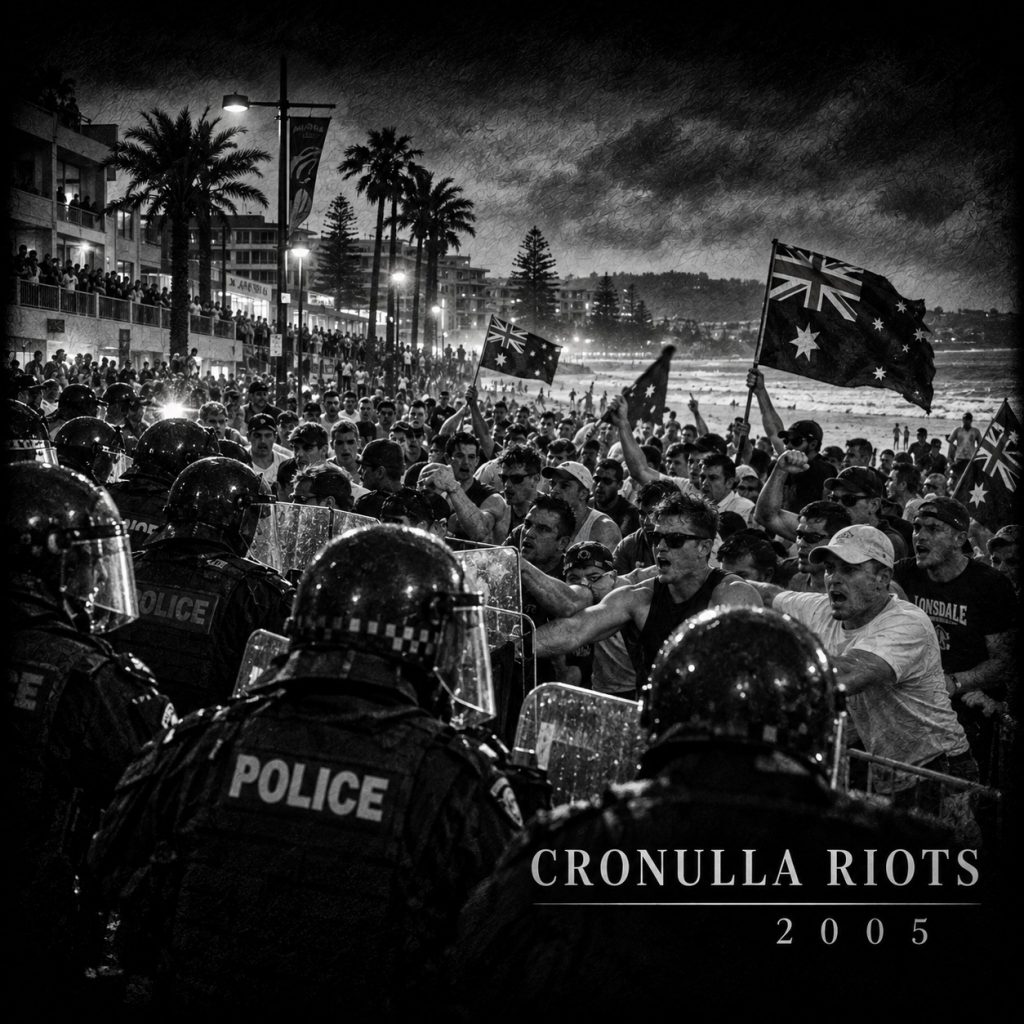
From 10am about 5,000 people gathered near the North Cronulla Surf Life Saving Club, mostly young Caucasian men, some draped in Australian flags. The police review found the gathering was at first peaceful, but that speakers "incited the crowd into a volatile mood that, coupled with excessive alcohol consumption, caused the violence that followed".
From about 1pm, people of Middle Eastern appearance were chased and assaulted. Two Middle Eastern men were punched and kicked in Dunningham Park. Two young women, one wearing an Islamic symbol, were abused and then punched and kicked outside the North Cronulla Hotel. A car carrying two Bangladeshi university students was attacked. At Cronulla railway station two men of Middle Eastern appearance were assaulted and followed onto a train, and police cleared the station with batons and capsicum spray. An ambulance carrying injured people was hit with bottles, and one struck an ambulance officer in the head.
The reprisals
That night, groups of Middle Eastern men gathered in parks at Punchbowl and Arncliffe and left in convoys towards Cronulla, Maroubra and Brighton-le-Sands. At Maroubra, about 100 men armed with baseball bats and other weapons damaged more than 50 parked cars, and residents were assaulted. One man was struck in the face with a baseball bat and knocked unconscious. At Brighton-le-Sands, an Australian flag was taken from the roof of the RSL club, stomped on and set alight.
The reprisals continued the following night, Monday 12 December. Nine News reported groups of men "terrorising motorists on the Kingsway at Cronulla" and targeting people in their homes; a resident filmed a group before it attacked with rocks and bottles. "A man putting out his garbage was set upon by two carloads of men and beaten. His ten-year-old son witnessed it all," Nine reported. At Brighton-le-Sands shops were trashed; one shop owner told Nine men from "six, seven" cars had come into his shop and said "I'm going to kill you". Nine reported that at least 30 carloads of men made it into the Sutherland Shire, that police found an iron bar during car searches, and that the night ended with five arrests. Earlier that evening a crowd of several hundred gathered outside Lakemba Mosque; the ABC reported a major police presence there and that police and ambulance officers recorded no arrests, violence or injuries at the gathering, although television crews had objects thrown at them. Lebanese community leader Dr Jamal Rifi said he had called the NSW Police Commissioner to warn of the expected retaliation (ABC).
Former NSW Police Assistant Commissioner Mark Goodwin, one of the police commanders in the response, later told A Current Affair: "The violence that was exhibited and the police dealt with was probably, I'd say at least 10 times, possibly up to 100 times worse than anything that occurred on the day at Cronulla." He described "mobile rioting", with "groups of up to 50 carloads of young men who were rampaging through suburbs", roadblocks and suburbs shut down, and "truckloads of weapons ... baseball bats, knives, guns", including a billiard table leg with nails driven through it. The program reported that crates of Molotov cocktails were seized and police learned of plans for mass attacks at Sydney shopping centres. Goodwin said: "We had very strong information and intelligence that there was going to be a drive-by shooting and a hand grenade thrown into the beer garden the following weekend at Northies," the North Cronulla Hotel. No such attack took place. The police operation, he said, "went on virtually the whole of the summer".
In 2024 Goodwin and Carl Scully, NSW Police Minister at the time of the riots, published The Cronulla Riots: The Inside Story (Connor Court Publishing). Interviewed on Sky News, Goodwin said the planned hand grenade attack on the North Cronulla Hotel beer garden had been taken "off the street" by an undercover operation, which he said the public did not know about and which is revealed in the book. Scully said: "We had intelligence, provable, demonstrable intelligence that Uzi machine guns had been bought. There was an attempt on the black market to buy a stolen military hand grenade. Baseball bats from Newcastle, Wollongong had been sold out and we needed to respond. And hence, I secured 2000 police under Mark's command." He said that when he formed the view that the Police Commissioner was not allocating enough personnel, he asked him whether he needed "to talk to the Premier and ask him to request soldiers and tanks with potential sanction of lethal force", which he called "the closest this country's probably ever got". These accounts are the authors' own; no weapons of that kind were reported as seized at the time.
Parliament was recalled for the emergency sitting on 15 December 2005. The second reading speeches by Premier Morris Iemma and, in the Legislative Council, John Della Bosca gave no details of weapons, intelligence or planned attacks. They cited "thuggery, intimidation and violence", said "louts and criminals have effectively declared war on our society", and referred to "the attacks on surf lifesavers and the disgraceful events that followed". The new lockdown powers, however, applied where disorder was "constituted by several smaller incidents in different locations" and to roads "used by people travelling to participate in the riot", and allowed police to seize vehicles and mobile phones for up to seven days (NSW Hansard, 15 December 2005).
Government Response
On 6 December, after a risk assessment, the Miranda Local Area Commander set up Operation Seta. The text messages were the main intelligence police were receiving. Operation Seta, led by Superintendent Ron Mason, went on to direct the response to the reprisal attacks.
Between 13 December 2005 and 14 July 2006, Strike Force Enoggera investigated the riot and the reprisals. It charged 104 people with 285 offences: 51 people and 136 charges over 11 December, and 53 people and 149 charges over the reprisal attacks.
Strike Force Neil, the later Hazzard review of the police response, concluded there were "two aspects to the conflict". It found "evidence of racism and bias amongst the Cronulla community, but there is also evidence across Sydney of a significant level of violent criminality being committed by an element of the Middle Eastern community".
The NSW Parliament enacted extraordinary public-order powers: Part 6A of the Law Enforcement (Powers and Responsibilities) Act 2002, inserted by the Law Enforcement Legislation Amendment (Public Safety) Act 2005. The NSW Ombudsman's September 2007 review recorded that they were enacted directly in response to the mob violence at Cronulla on 11 December 2005 and the reprisal attacks in the days that followed.
The policing response included large deployments, vehicle and movement controls, and intensive operations to prevent further violence.
Summary
On 4 December 2005, two lifesavers were assaulted at North Cronulla. The police review later found the fight was over quickly, and that the reporting of it was "significantly out of proportion". A week of talkback radio and more than 270,000 text messages followed. The media regulator later found 2GB and Alan Jones had broadcast material likely to encourage violence and to vilify people of Lebanese and Middle Eastern background.
On 11 December about 5,000 people gathered at Cronulla, and people of Middle Eastern appearance were chased and assaulted. That night, convoys of Middle Eastern men attacked people and cars in Maroubra and other suburbs. Police charged 104 people: 51 over Cronulla and 53 over the reprisals. Parliament gave police new emergency powers.
Cronulla became a national argument about race, identity, policing, multiculturalism, crime, media influence and who had the right to claim public space.
The police review is a public document, and the regulator's finding is on the record.
You be the judge.
Evidence
- Strike Force Neil report - part 1
- Strike Force Neil report - part 2
- Strike Force Neil report - part 3
- Strike Force Neil report - part 4
- ABC News, Major police presence at Lakemba Mosque, 12 Dec 2005
- Podcast: Riots and revenge attacks - Carl Scully and Mark Goodwin
- Book: The Cronulla Riots: The Inside Story, Carl Scully and Mark Goodwin (Connor Court, 2024)
- Sky News (News24): Undercover operation foiled grenade attack at Northies after Cronulla riots, new book reveals
- NSW Legislative Assembly Hansard, second reading, Law Enforcement Legislation Amendment (Public Safety) Bill, 15 Dec 2005