 5 OCT 2026
Government’s response Islamophobia
7 OCT 2026 The Herzog Protests
Israeli President Isaac Herzog made a four-day visit to Australia, which the ABC described as "initiated by the governor-general and prime minister to support people grieving those killed in an attack on a Hanukkah gathering". On 9 February 2026 thousands attended a Palestine Action Group rally at Sydney Town Hall, and rallies were also held in Melbourne, Canberra, Brisbane and Hobart. The Sydney rally went ahead after the organisers lost a last-minute legal challenge to a major event declaration that gave police expanded powers, and marching was prohibited.
NSW Police said 27 people were arrested, including 10 for assaulting police, and officers used pepper spray (ABC). Assistant Commissioner Peter McKenna said officers were "jostled, threatened and assaulted". Nine people, aged 19 to 67, were later charged (BBC; SBS). Video showed police dragging away a group of Muslim men who were praying in the Town Hall forecourt, led by Sheikh Wesam Charkawi (Guardian). Greens MLC Abigail Boyd said she was hurt by police (SMH).
Premier Chris Minns defended police: "It was, in effect, in the middle of a riot." NSW Police later said a senior officer had agreed to let the prayer finish, "However, some worshippers were moved on before the message from the senior officer was able to be relayed." Commissioner Mal Lanyon said: "I have apologised for any offence taken for interfering with that religious process" (Guardian, 13 Feb).
The Law Enforcement Conduct Commission opened an investigation (Operation Makalu) "Following the receipt of a significant number of complaints". The LECC's progress update says public examinations will not be held in September 2026 because of procedural issues. No findings had been published when the page was checked on 5 October 2026.
More sources:
7 OCT 2026 
ISIS Brides return to Australia
On 6 May 2026 Home Affairs Minister Tony Burke confirmed that 13 members of the Australian cohort in Syria, four women and nine children, had made plans to travel to Australia. They arrived in Sydney and Melbourne on 7 May. The NSW Joint Counter Terrorism Team arrested a 32-year-old woman at Sydney Airport and charged her with entering or remaining in a declared area and being a member of a terrorist organisation (AFP). She was refused bail (ABC), and the ABC named her as Janai Safar. The Victoria JCTT charged two women, aged 53 and 31, with crimes against humanity (enslavement) and slavery offences. The AFP alleges one "was complicit in the purchase of a female slave for US$10,000, and knowingly kept the woman in the home". A fourth woman was not arrested (ABC).
On 26 May 2026 two flights brought a further 19 women and children to Melbourne and Sydney. Burke's statement listed "seven women and 12 children" as planning to travel, while the ABC reported that six women arrived. No one was arrested, but the AFP said investigations were continuing (ABC). Confirming their return, Burke said the government "has not and will not provide any assistance to this group" (BBC). The BBC reported they were understood to be the last Australians in al-Roj camp. One woman subject to a temporary exclusion order remained in Syria with her child.
On 28 May 2026 the Victoria JCTT charged a woman, 34, who had returned from Lebanon in September 2025, with terrorism offences. According to the AFP release, Deputy Commissioner Hilda Sirec "said the JCTTs had charged four women in the past three weeks for alleged crimes against humanity and terrorism-related offences". AFP Commissioner Krissy Barrett said planning for the returns began in 2015 under what became Operation Kurrajong.
Lebanese Muslim Association secretary Gamel Kheir defended the women's return, telling Daily Mail Australia (8 May 2026): "I am no defender of these individuals. I am no defender of ISIS. If they are guilty of breaking Australian law, charge them." He added: "I don't care what the government does or doesn't do, I care even less what the Opposition thinks."
More sources:
- afp.gov.au
- afp.gov.au
- afp.gov.au
- minister.homeaffairs.gov.au
- minister.homeaffairs.gov.au
- abc.net.au
- abc.net.au
- abc.net.au
- bbc.com
- theguardian.com
- bbc.co.uk
- Daily Mail Australia - Muslim leader defends ISIS brides' return (Caitlin Powell, 8 May 2026) - copy held by The Evidence Project
7 OCT 2026 Two preachers’ visas cancelled over antisemitic remarks
In late March 2026, two Bangladeshi preachers, Mizanur Rahman Azhari and Shaykh Ahmadullah, arrived in Australia on visitor visas for a speaking tour of Brisbane, Melbourne, Sydney and Canberra organised by the Islamic Practice and Dawah Circle (IPDC).
Bangladesh's Daily Star reported that Azhari's past sermons had described Adolf Hitler as divine punishment for Jews and called Jewish people "the biggest terrorists of the world" and a "poisonous blemish". In 2021 he had been stopped from boarding a flight to the UK (NCA NewsWire). Australian authorities cancelled his visa on Tuesday 31 March 2026, partway through the tour, and the Melbourne, Sydney and Canberra events were cancelled. Senator Jonno Duniam said: "There's a litany of examples of antisemitic hate speech, his maligning of the Hindu religion, demonising of the Bengali culture." Azhari said his remarks had been "taken out of context".
The Australian Jewish News reported that Ahmadullah had said Jewish people "keep the whole world in turmoil". His visa was revoked on Sunday 5 April 2026, after he had already left Sydney, which prevents him returning.
NCA NewsWire reported that The Daily Telegraph had revealed Azhari's visa was revoked after Home Affairs Minister Tony Burke was asked to remove him by the community group Australian Federation for Ethnic and Religious Minorities in Bangladesh, and that Burke cancelled the visa "after becoming aware of the case". Senator Duniam said several MPs had been alerted to Azhari's arrival by community organisations. AIJAC's Joel Burnie said the case "exposed a fundamental failure in Australia's immigration screening" (Australian Jewish News).
Two months earlier, in January 2026, Burke had cancelled the visa of Israeli influencer Sammy Yahood hours before he flew to Australia, saying "Spreading hatred is not a good reason to come" (Al Jazeera).
More sources:
7 OCT 2026 Hizb ut-Tahrir listed as a prohibited hate group
The Department of Home Affairs national security website says: "The Australian Government listed Hizb ut-Tahrir as a prohibited hate group under the Criminal Code on 5 March 2026. The regulations came into effect on 6 March 2026." The legal instrument is the Criminal Code (Prohibited Hate Group—Hizb ut-Tahrir) Regulations 2026 (F2026L00210), made by the Governor-General on the advice of the Federal Executive Council.
Home Affairs Minister Tony Burke said it was "the first listing under the new prohibited hate group listing framework", which is part of the Combatting Antisemitism, Hate and Extremism (Criminal and Migration Laws) Act 2026. He said it was now a criminal offence "to be a member of, recruit for, provide training or funds to, or provide material support to Hizb ut-Tahrir." He also said: "For a long time, Hizb ut-Tahrir has been able to spread hate and create a pathway for others to engage in violence." ABC reported that the offences carry a maximum penalty of 15 years' imprisonment.
ABC reported that the laws were passed in response to the Bondi terror attack of December 2025. It said Hizb ut-Tahrir had "been on Australian spy agency ASIO's radar for years, but had previously fallen short of meeting the legal bar to be formally banned". Mr Burke said ASIO's recommendation was a key condition of the listing. Shadow Home Affairs Minister Jonno Duniam said the listing showed the laws were working as intended. (SBS reported that the listing took effect on the Thursday, 5 March. The official Home Affairs page gives 6 March as the date it came into effect.)
More sources:
7 OCT 2026 Royal Commission on Antisemitism and Social Cohesion – hearings
The Governor-General issued Letters Patent on 9 January 2026 establishing the Royal Commission on Antisemitism and Social Cohesion, with the Hon Virginia Bell AC SC as Royal Commissioner. SBS reported that it was set up in response to the Bondi Beach terror attack, in which 15 people were killed at a Hanukkah celebration in December 2025. The Commission held its opening hearing on 24 February 2026. After the Bondi attack, Prime Minister Anthony Albanese had first appointed former ASIO Director-General Dennis Richardson to lead a review of the intelligence and law enforcement agencies; that review was folded into the Royal Commission, and Richardson became a special adviser to the Commission. At the opening hearing, Commissioner Bell said delays made it "unlikely that counsel assisting the commission will be in a position to adduce evidence concerning the adequacy of the security arrangements" in time for the interim report (ABC). Richardson resigned on 11 March 2026, and Bell thanked him without giving a reason. Richardson later said he felt "surplus to requirements" and was "way overpaid for what I was doing" (the Australian Financial Review reported his rate as $5,500 a day). He also said that on the intelligence findings "it cannot wait until December", and that the interim report would be "a very different document to the one that I would have done when I was doing the review, prior to the royal commission being announced" (ABC, SBS). The Interim Report was tabled in Parliament on 30 April 2026.
According to the Commission, nine hearing blocks followed: nature and prevalence (May); Bondi (from 25 May); online, social media and media; universities; community security; guidance and training; protests and policing; drivers and deradicalisation; and social cohesion (17–26 August 2026). Parts of the Bondi block were closed to the public "to avoid prejudice to national security and/or the ongoing criminal proceedings relating to the attack." At the opening of that block, ABC reported that counsel assisting Richard Lancaster SC said 11 people were shot within 29 seconds of the attack starting, 10 of them fatally. ABC also reported that ASIO Director-General Mike Burgess told the Commission: "We can't be everywhere all at once."
A former ASIO undercover agent known as "Marcus", who told Four Corners that ASIO was warned in 2019 about Naveed and Sajid Akram, sought to give evidence. Immigration authorities refused both of his applications for a visa to travel to Australia, saying they were "unconvinced he intends to stay temporarily". Home Affairs Minister Tony Burke said he was "free to give evidence in public"; Commissioner Bell said the Commission would not hear his evidence in open hearings because of the risk of prejudicing separate criminal proceedings. ASIO has called him "disgruntled and unreliable", which he rejects. As at 29 August 2026, after the scheduled hearings had ended, the Commission said it had yet to hear from him and was working with DFAT to find a secure overseas venue (ABC).
SBS reported that more than 340 witnesses gave evidence over 62 days. The Commission's own figures, as at 11 September 2026, are 347 witnesses and 20,000 submissions. On 3 September 2026, amended Letters Patent moved the final report deadline from 14 December to 18 December 2026. SBS reported that the extension followed Jewish community concern about the report landing on the anniversary of the attack.
More sources:
- asc.royalcommission.gov.au
- asc.royalcommission.gov.au
- asc.royalcommission.gov.au
- abc.net.au
- sbs.com.au
- abc.net.au - Dennis Richardson says sense of urgency 'didn't quite align' with royal commission (14 Mar 2026)
- sbs.com.au - Former ASIO chief says he quit antisemitism royal commission as he felt 'surplus'
- abc.net.au - Ex-ASIO source denied visa to give evidence at royal commission (23 Jul 2026)
- abc.net.au - Ex-ASIO agent can give evidence in open hearings, minister confirms (21 Aug 2026)
- abc.net.au - Former ASIO agent offers to give evidence from abroad (29 Aug 2026)
Imams council demands end to ‘radical Islam’ wording after Morrison’s reform call
On 27 January 2026, speaking at an antisemitism conference in Israel, former prime minister Scott Morrison called for reform of how Islam is "practised and governed in Australia" after the Bondi Beach attack, saying such questions could not remain "taboo". He said: "I am advocating reforms I believe will help religious leaders in our Islamic community keep the wolves from their flock." Liberal Senator Andrew Bragg separately said on ABC Radio that Muslim leaders should "take responsibility".
The next day, 28 January 2026, the Australian National Imams Council (ANIC) issued a statement calling their comments "reckless, irresponsible, and deeply ill-informed". It said: "Associating terrorism with Islam is wrong, rejected, and has no factual or moral basis. We cannot and must not blame entire communities for the actions of a few criminal individuals." ANIC added: "We call on former Prime Minister Scott Morrison, Senator Bragg, and all political parties and leaders to act with responsibility, restraint, and integrity in their public commentary, and to refrain from using divisive and misleading terms such as 'radical Islam', 'extremist Islam' or other divisive language." ANIC president Imam Shady Alsuleiman was quoted in the statement: "To blame an entire community for the actions of a few criminal terrorists is unacceptable, rejected, and undermines our social cohesion." The statement pointed to the 2019 Christchurch mosque attack by a man "radicalised on Australian soil", saying "no collective blame was placed on a race, religion, or community" then. The statement also said the 2018 Bourke Street attacker "was later confirmed to be mentally ill". The Victorian Coroner found in June 2021 that the attack was "a premeditated act of terrorism, an ISIS-inspired attack attributable to his adherence to an extremist interpretation of Islam", and said mental illness could not be ruled out because there was not enough evidence (ABC).
Morrison replied on social media the same day that he was "asking for Islamic leaders to regulate and provide stronger protections against radicalisation within the Islamic faith community", adding: "This is not about blame for December 14 - that is a straw man argument - but an honest appeal for what is needed to prevent such radicalisation in the future."
More sources:
- anic.org.au - ANIC statement, 28 January 2026 (official release)
- news24.com.au - Morrison responds as Australia's peak imams body demands end to terms like 'radical Islam' (28 Jan 2026)
- The Australian - "Stop saying 'radical, extremist' Islam: imams" (28 Jan 2026)
- abc.net.au - Bourke Street inquest finds attacker was motivated by Islamic State (28 Jun 2021)
ASIO chief: Islamic extremism is about 70% of caseload; 16 plots stopped since Bondi
In an interview on Neil Mitchell's Mitchell Unlimited podcast, released in September 2026, ASIO Director-General Mike Burgess said: "I bristle when I hear people saying that we have a growing Islamic extremism problem in this country. We don't. We have an Islamic extremism problem in this country. That is true. It is not growing, but it's still a problem. It represents about 70% of my organisation's caseload."
He said that since the Bondi Beach attack, "my agency and the police have prevented ... activities of individuals that could have led to an attack. 16 of those events have been stopped by the Police and Security Service since Bondi." Left unchecked, he said, they could have led to a terrorist attack resulting in harm or loss of life.
Burgess also said that "some people are confusing Islamic extremism with the good people of Islamic faith. They are not the same thing," adding that Muslim Australians were "on the receiving end" of Islamophobia. He told Mitchell: "I wouldn't rule out the possibility that Iran would want to kill prominent Jewish Australians," and said he had raised this with community leaders.
The Sydney Morning Herald reported that ASIO and the Department of Home Affairs had begun reviewing the national terrorism threat advisory system, which Burgess said "was not designed for a situation like the one we now face"; he described the threat as at "the upper end of probable".
In his 2026 Annual Threat Assessment speech on 24 June 2026, three months earlier, Burgess said: "In the aftermath of Bondi there were calls for greater focus on countering Sunni violent extremism. This made sense when ISIS and al-Qaeda were the principal security threats, but contemporary terrorism is far more complex and this is borne out by recent events." He then cited two Western Australian cases: a man charged with throwing a homemade bomb, which did not detonate, into an Invasion Day rally in Perth in January, allegedly inspired by neo-Nazi ideology; and a man charged in February with allegedly preparing a mass-casualty attack on WA Parliament House, police headquarters and mosques, allegedly motivated by extreme right-wing ideology. Neither case has gone to trial. In the same speech he said Islamic State and al-Qaeda were "growing their capability to conduct and inspire attacks", and that ASIO and police had foiled "31 major plots since 2014", including 14 since Bondi.
The figure has moved over time. At Senate Estimates in February 2023 Burgess said "70 per cent [are] religiously motivated, and 30 per cent [are] ideologically motivated" (ABC). In ASIO's 2025 Annual Threat Assessment, fewer than half of the potential terrorism matters investigated in the previous year were religiously motivated.
Video: https://www.youtube.com/watch?v=7xFY8z0VeBc (relevant section from 25:56; 16 plots from 45:38)
More sources:
- The Sydney Morning Herald, "Low, moderate, critical: ASIO boss sounds alarm on urgent upgrade of Australia's terror warnings", Matthew Knott, 18 September 2026 (copy held)
- abc.net.au - Right-wing terror threat has receded, ASIO chief says (13 Feb 2023)
- asio.gov.au - Director-General's Annual Threat Assessment 2025
- ASIO - Annual Threat Assessment 2026, Director-General of Security (24 June 2026), from 8:43
“ABC Misinformation Report” dossier published
In May 2026 a 58-page dossier titled the "ABC Misinformation Report" was published by an "Independent Research Group" of four Jewish Australian researchers, who kept their identities hidden, they said, to avoid harassment. It argues that the ABC, a publicly funded broadcaster with a legal duty of accuracy and impartiality, showed "a pattern of systematic missteps that resulted in disinformation" in its Gaza war coverage, and that this "vilifies Israel and, by extension, Jews" and contributed to antisemitism in Australia. The report was covered by The Australian (Chris Kenny), The Jerusalem Post and Quadrant.
The dossier groups its examples under three headings it calls the "famine", "baby killers" and "genocide" narratives. Among its claims:
- Images of sick children presented as starving: it says the ABC used images of children with genetic or medical conditions, including a boy with cerebral palsy shown during an interview with the Prime Minister on 27 July 2025, as evidence of famine. The ABC acknowledged the boy's pre-existing condition in an article on 31 July 2025.
- "14,000 babies": the ABC broadcast a UN official's claim that 14,000 babies could die within 48 hours. The ABC Ombudsman later found that ABC News Breakfast and ABC News Mornings breached the ABC's editorial standards on accuracy and on correcting errors (standards 2.1 and 3.1a), and Afternoon Briefing breached the accuracy standard (2.1), in its coverage on 21 May 2025 (finding published 19 June 2025).
- "Genocide scholars": it says the ABC described the International Association of Genocide Scholars as "the world's leading association of genocide scholars" when reporting its September 2025 resolution, without telling audiences that membership required no academic qualifications.
- Sources: it says the ABC relied on sources linked to Hamas, often without disclosure, and that ABC headlines in the two weeks after 7 October 2023 were four to five times more sympathetic to Gaza than to Israel.
The dossier says that where the ABC acknowledged errors, corrections were "delayed, minimised, or buried in low-visibility formats". These are the dossier's claims; apart from the Ombudsman findings and ABC clarifications cited above, they have not been tested by the ABC or an independent body.
More sources:
- The ABC Misinformation Report - full document (PDF, 58 pages)
- ABC Ombudsman - breach finding, '14,000 babies in Gaza' (published 19 Jun 2025)
- ABC Ombudsman - resolved complaint (AM / The World Today, Aug 2025)
- Jmedia Online - interview with two of the report's co-authors (13 Jun 2026)
- The Daily Declaration - new dossier shows the ABC spreading Gaza war falsehoods (14 May 2026)
- Quadrant - Their ABC's Gaza Fantasyland
Introduction
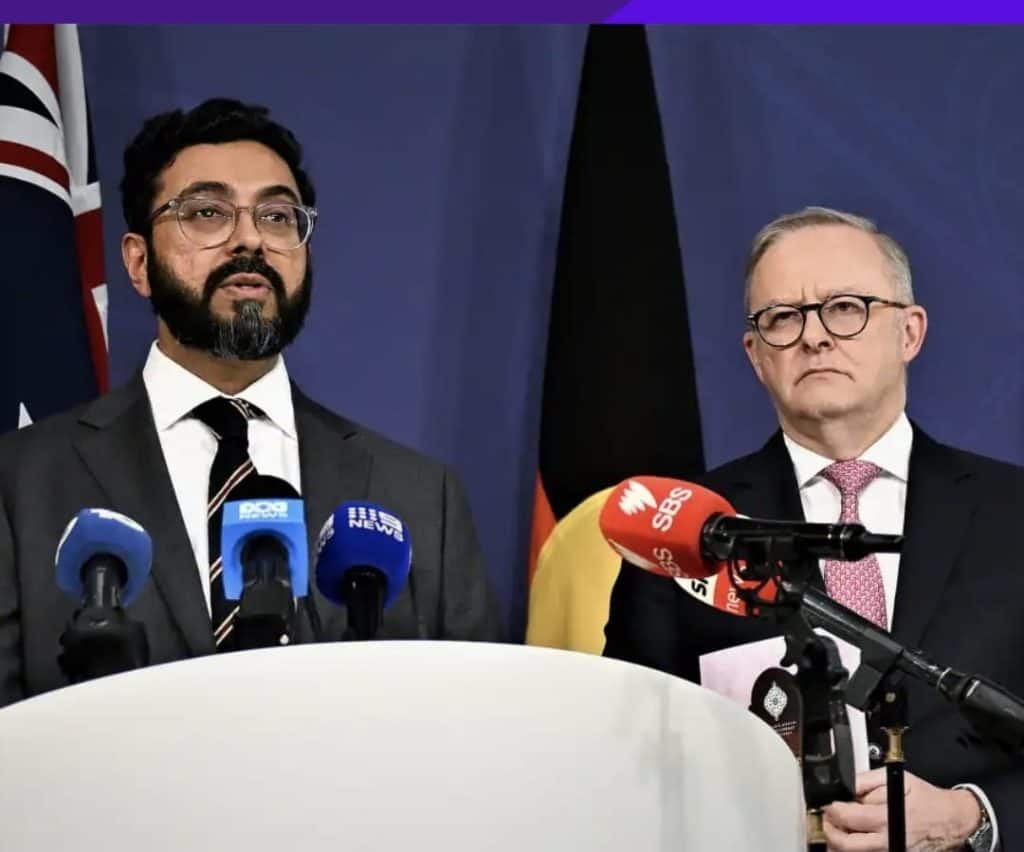
On 18 July 2026, Prime Minister Anthony Albanese announced the Australian Government's response to the report of Australia's Special Envoy to Combat Islamophobia, Aftab Malik. Malik had delivered his report, A National Response to Islamophobia: A Strategic Framework for Inclusion, Safety and Prosperity, on 12 September 2025, containing 54 recommendations following what his office described as hundreds of hours of consultation with Muslim communities, leaders and Australian and international experts.
The response came almost ten months after the report was released. Before the announcement, Malik had publicly urged the government to act, warning in May 2026 that it should not wait for another Christchurch-style attack before responding. The government said the delay reflected consultation and coordination across portfolios, and that some of the recommended measures were already underway.
Albanese said Islamophobia had "no place in Australia" and described the government's response as practical action intended to keep communities safe and strengthen social cohesion. The response was organised around four themes identified by Malik: education and awareness; protection and support; building social cohesion; and accountability and responsibility.
The government said it was accepting 35 of the 54 recommendations, but it did not publish a numbered list showing which 35. The government response instead describes a series of measures under the four themes, so working out which recommendation each measure corresponds to means comparing the two documents. ABC and SBS reported the government's position as acceptance of 35 of 54 recommendations.
Malik's report was not a general statement of support for Muslim communities. Its recommendations included proposals concerning Australia's discrimination laws, counter-terrorism laws, inquiries into Islamophobia and anti-Palestinian and anti-Arab racism, parliamentary conduct, education, policing, mental health and the collection of data on Islamophobic incidents.
The government accepted a substantial package of measures, while some of the report's legal and policy recommendations were left unresolved or rejected.
Government Response
The government's response committed to an Islamophobia Education Taskforce, involving state and territory education authorities, agencies and departments. It also announced a continuing Social Cohesion Education Advisory Council, a review of the Australian Curriculum to identify opportunities to strengthen racial and religious tolerance, and a Social Cohesion Framework for schools addressing Islamophobia and racism.
The government also committed to training and professional-development resources for parliamentarians, their staff and Australian Public Service employees. The Australian Federal Police is to undertake a stocktake of existing anti-racism and cultural-sensitivity training, with a view to developing resources focused on religious sensitivity.
A new Australian Muslim Affairs research institute is also part of the package. The government says it will support research into the nature, impacts and gendered dimensions of Islamophobia, as well as cultural and educational initiatives concerning Muslim history and identity. Funding will also support young Muslim creatives and programs intended to promote cross-cultural understanding.
The response includes measures dealing with mental health and community resilience. The government says Primary Health Networks will receive targeted support for Muslim community organisations, and that work will begin on an Islamophobia-related trauma protocol for mental-health services. New multicultural grants are directed towards culturally appropriate mental-health services, leadership and advocacy, Muslim women's economic participation and leadership, and youth development.
The government also points to $41.9 million already allocated across initiatives intended to improve security at Muslim faith-based places, foster social cohesion and meet the needs of Australian Palestinian, Muslim and Arab communities. It says an Australian Research Council project is conducting Australia's first longitudinal study of Islamophobia and its social, economic, educational and mental-health impacts.
On policing, the government announced an expansion of Australian Federal Police Community Liaison teams and a communications portal intended to provide information to communities affected by hate crime and improve awareness of reporting mechanisms. It also committed to finalising an AFP Social Cohesion Consultative Board involving community leaders, young people and non-government organisations.
The response also includes funding for sporting and community activities, an additional $2.6 million over four years for the Office for Multicultural Affairs to deliver measures combating Islamophobia, and additional mental-health support. The government's document says the Program of Assistance for Survivors of Torture and Trauma and targeted Primary Health Networks are receiving an additional $6 million for mental-health and wellbeing support.
Some of Malik's central legal recommendations were not adopted.
The government did not agree to overhaul Australia's counter-terrorism framework in response to Malik's concerns that reliance on ideological, political or religious motivation could produce discriminatory effects. Asked about the issue, Albanese said the government operates its terrorism laws on advice from national-security agencies and that he had confidence in that advice.
Malik had separately argued in a June 2026 submission to the Royal Commission on Antisemitism and Social Cohesion for changes to the definition of a terrorist act to reduce reliance on ideological, political or religious motivation as a central criterion. The government did not adopt that proposal in its Islamophobia response.
The government also did not establish the proposed commission of inquiry into anti-Palestinian and anti-Arab racism. Instead, it pointed to the longitudinal Australian Research Council study of Islamophobia and said it would consider how the study's findings could be analysed, including their gendered impacts.
The response also did not introduce the stronger and more specific legal protections for Muslims that Malik sought. The government said it would continue to ensure that legislative settings remained fit for purpose and provided effective protections for all Australians, including Muslim communities. It noted that the Standing Council of Attorneys-General had considered coordinated responses to vilification, including Islamophobia and antisemitism, but left the legislative framework under ongoing consideration.
The government drew a line between measures it could implement through programs, education, funding, policing and community engagement, and recommendations that would require changes to legislation or national-security policy.
Albanese made that distinction explicit. He said Malik's report was independent advice and that government could not "contract out" its decision-making responsibilities.
Summary
The Albanese Government accepted 35 of the 54 recommendations contained in Aftab Malik's report, according to the Prime Minister and subsequent reporting. The measures accepted or advanced include education initiatives, curriculum review, parliamentary and public-service training, multicultural grants, Muslim women's and youth programs, mental-health support, an Australian Muslim Affairs research institute, improved hate-incident reporting, expanded AFP community liaison and social-cohesion structures, and additional support for Muslim institutions and communities.
The government did not accept the report in full.
Among the recommendations it did not adopt were proposals connected to counter-terrorism law, stronger legal protections concerning religious discrimination, and a commission of inquiry into anti-Palestinian and anti-Arab racism.
Instead, the government relied on existing legislative frameworks, national-security advice and research programs.
The Special Envoy welcomed substantial parts of the response but made clear that he regarded the process as unfinished. Malik said his original report remained his independent advice to the government and the benchmark against which progress should be measured. He said he would support areas where the government had acted and keep advocating for the recommendations still outstanding.
The Alliance of Australian Muslims and the Australian National Imams Council gave the response a broadly positive reception, describing it as an "unprecedented and important step in the right direction". The organisations also said considerably more remained to be done, and called for clear commitments, resources and accountability.
ANIC senior adviser Bilal Rauf identified what he described as a major omission: legal consequences and enforcement. He contrasted the response with the government's approach to antisemitism, arguing that the Islamophobia response placed comparatively greater emphasis on education, grants and community programs and less on legislative enforcement. That is a criticism from a Muslim community representative, not an established fact about government intent.
The government's response to the antisemitism envoy provides a point of comparison.
In December 2025, the Albanese Government formally adopted the Special Envoy to Combat Antisemitism's 13 recommendations and stated that it was taking action on all 13. The government also pointed to laws it had already passed on hate speech, hate symbols and doxxing, and announced further hate speech measures.
The Islamophobia response, delivered seven months later, was materially different. The government accepted 35 of 54 recommendations but did not accept the report in full, particularly where the recommendations intersected with counter-terrorism law, discrimination law and proposed inquiries. The government has defended the distinction by pointing to the different policy and national-security considerations involved.
The government has acted on a substantial portion of the Islamophobia envoy's recommendations, but it has not adopted the report as a whole.
The published response also raises a question of transparency.
The government says 35 of the 54 recommendations have been accepted, but the published response is organised by policy theme rather than by recommendation number. Without comparing the two documents, a reader cannot check the 35/54 figure or identify exactly which recommendations have been accepted, partially accepted, deferred or rejected. SBS likewise reported that the government had not specified which recommendations it would adopt.
The government has now provided its formal response, ten months after Malik's report.
What those commitments change in schools, universities, policing, community safety, mental health, public administration and Australian law will depend on implementation.
The government has chosen which recommendations to pursue.
Malik has made it clear that he intends to keep pressing for the rest.
You be the judge.