 7 OCT 2026
Bali Bombings
7 OCT 2026 ASIO raids on Jemaah Islamiyah suspects in Sydney and Perth
Australia listed Jemaah Islamiyah (JI) as a terrorist organisation under the Criminal Code with effect from 27 October 2002, 15 days after the Bali bombings. The BBC reported that the listing allowed the government "to use tough anti-terror legislation against suspected members". It also reported that Australia believed JI was involved in the Bali attack, in which "more than 180 people were killed, including about 90 Australians".
On the evening of Sunday 27 October 2002, armed officers searched the Sydney flat of Jaya Fadly Basri. The Sydney Morning Herald reported this happened "just hours after Jemaah Islamiyah's listing". Officers spent two hours going through computer records and documents. His lawyer, Stephen Hopper, told the BBC: "He would not have anything to do with a terrorist organisation and finds violence an abhorrent concept." Basri told the SMH he had attended "two or three" public lectures by Abu Bakar Bashir, the latest in 1997.
Early on Wednesday 30 October 2002, armed police raided the home of an Indonesian Muslim family in Thornlie, Perth. A neighbour told the ABC: "There were six or eight uniformed police officers with black helmets, black balaclavas, black flak jackets... like it was from a movie scene". The AFP referred all inquiries to Attorney-General Daryl Williams. The BBC said no arrests were reported in either raid.
More sources:
7 OCT 2026 Australia’s first national terrorism laws passed
The Security Legislation Amendment (Terrorism) Bill 2002 [No. 2] was a government bill from the Attorney-General's portfolio. Parliament describes it as "Part of a package of four bills". It amended the Criminal Code Act 1995 to "insert new offences in relation to treason and terrorism related activities, all of which carry a penalty of life imprisonment". It also provided for "ministerial declaration of proscribed organisations" and created offences for membership of, or links with, such organisations.
The bill was introduced and passed in the House of Representatives on 13 March 2002. In the Senate it was debated from 20 June and amended in Committee of the Whole on 24–26 June. Its third reading passed on 27 June 2002. The House agreed to the Senate amendments the same day, and it received Royal Assent on 5 July 2002 as Act No. 65 of 2002.
The Attorney-General's Department's national security website states: "In 2002, a range of terrorist organisation offences were inserted into the Criminal Code Act 1995". Under this framework, Australia listed al-Qa'ida (21 October 2002) and Jemaah Islamiyah (27 October 2002) as terrorist organisations.
More sources:
7 OCT 2026 Moscow theatre siege
On 23 October 2002, about 40 Chechen militants led by Movsar Barayev took hundreds of people hostage at the Dubrovka Theatre in Moscow during a performance of the musical Nord-Ost. The BBC later put the number at 912 hostages. Three days later, Russian security services pumped a gas into the hall, stormed it and killed all the attackers. In 2002 the BBC reported that "Almost all the 117 hostages who were killed... died from gas poisoning", while BBC reporting in 2012 put the toll at "some 130 hostages". ABC AM reported that Russian authorities identified the gas as a fentanyl-based anaesthetic, though the BBC reported in 2012 that its exact name and formula had never been disclosed. In December 2011 the European Court of Human Rights ruled in favour of 64 victims.
Australian angle: during the siege, Foreign Minister Alexander Downer said "up to two Australians were caught in the theatre", one of them an academic (Sydney Morning Herald). ABC AM identified a hostage as Alex Bobik, a 56-year-old Melbourne academic. He survived and spoke to the ABC as he left intensive care in a Moscow hospital. He said: "we had a lot of support from the Australian Embassy that we were in contact with continually".
More sources:
Introduction
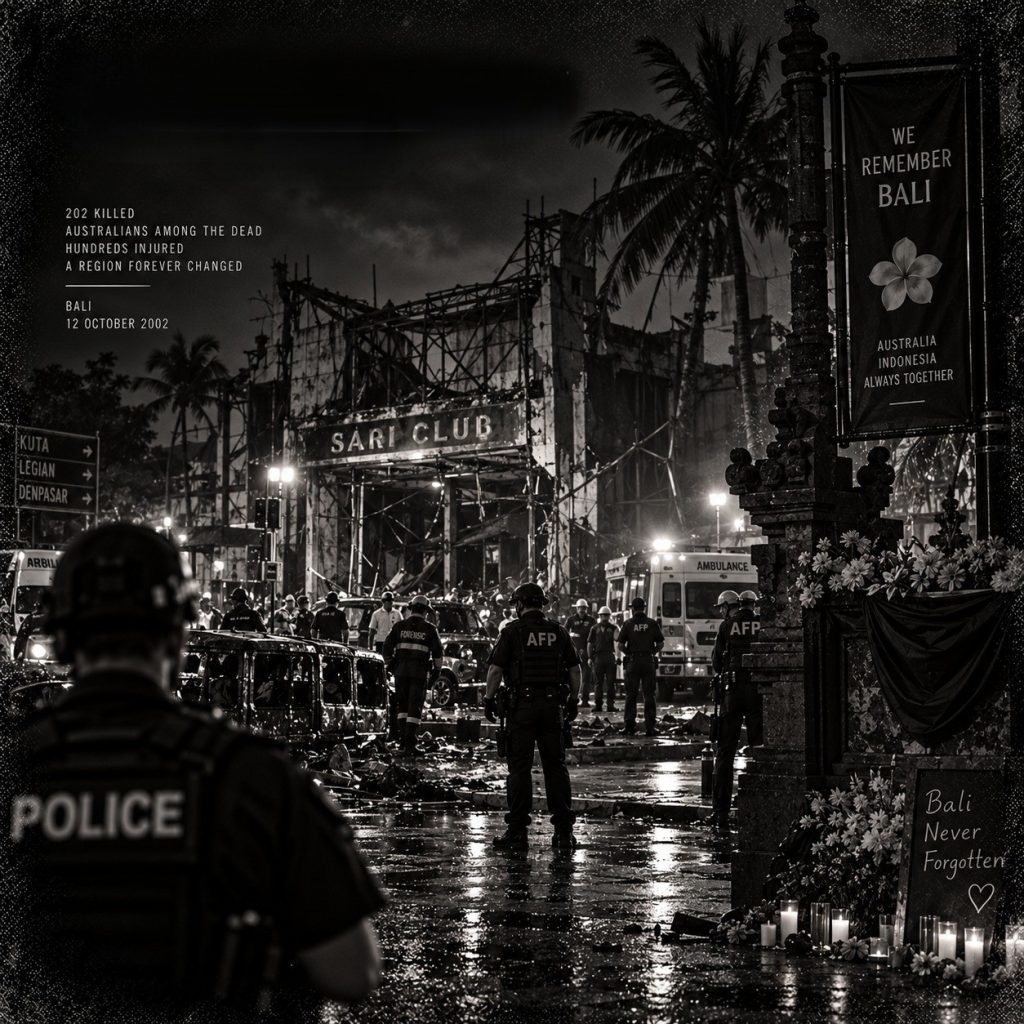
On the night of 12 October 2002, three bombs were detonated in Bali, Indonesia. The first was a backpack device carried by a suicide bomber into Paddy's Irish Pub in the Kuta tourist district. Seconds later, a much larger vehicle bomb, a Mitsubishi L300 van packed with a potassium chlorate-based charge, was detonated outside the Sari Club across the road. A third, smaller device exploded near the United States consulate in Denpasar, causing minor damage and no casualties.
Two hundred and two people from at least 21 countries were killed, 88 of them Australian. It remains the largest single loss of Australian life in a terrorist attack.
The attack was carried out by Jemaah Islamiyah, a Southeast Asian jihadist organisation with links to al-Qaeda.
Government Response
The Australian Federal Police deployed to Indonesia under Operation Alliance, working alongside the Indonesian National Police investigation, Operation Wira Sardana. In its own institutional history, the AFP describes the operation as a watershed moment for Australian national security and the foundation of its ongoing relationship with the Indonesian National Police.
The prosecutions were conducted in Indonesia, not Australia. Amrozi bin Nurhasyim was arrested on 5 November 2002 in East Java. He had procured about 1,100 kilograms of explosive material and the van. Imam Samudra, the field commander who selected the targets, was arrested on 21 November 2002 in West Java and convicted on 10 September 2003. Ali Ghufron, known as Mukhlas and Amrozi's brother, was arrested on 4 December 2002 and identified as the overall coordinator.
All three were executed by firing squad on the island of Nusakambangan on 9 November 2008. In total, more than thirty people were convicted.
A national memorial service was held at Parliament House in Canberra.
Summary
On 12 October 2002, Jemaah Islamiyah bombs in Kuta killed 202 people, 88 of them Australian. The AFP worked the case with Indonesian police. Indonesia tried more than thirty people and executed three of the bombers in 2008.
Three more attacks on Western or Australian targets in the region followed: the Marriott Hotel in Jakarta in 2003, the Australian Embassy in Jakarta in September 2004, and a second attack in Bali on 1 October 2005 which killed twenty people, four of them Australian.
The 2002 attack came seven months after the Australian Parliament passed the Security Legislation Amendment (Terrorism) Act 2002, which created terrorism offences in Australian law for the first time. Those offences had not yet been tested in an Australian court.
What the government knew before the attack, what it did afterwards, and what happened to the men responsible is set out in the evidence below.
You be the judge.