 7 OCT 2026
Christchurch Mosque Shootings
7 OCT 2026 Islamic State leader al-Baghdadi killed
Abu Bakr al-Baghdadi, the leader of Islamic State, died during a night raid by US special operations forces on a compound in Syria's north-western Idlib province. President Donald Trump announced the death at the White House on 27 October 2019. In the official record of his remarks he said: "Last night the United States brought the world's number-one terrorist leader to justice. Abu Bakr al-Baghdadi is dead."
Trump said al-Baghdadi fled into a dead-end tunnel with three of his children and "ignited his vest, killing himself and the three children". He said test results gave positive identification. AP reported that Defense Secretary Mark Esper said two US service members suffered minor injuries. National security adviser Robert O'Brien said the remains would be buried at sea.
On 28 October 2019, Prime Minister Scott Morrison, Foreign Minister Marise Payne and Defence Minister Linda Reynolds issued a joint statement. It said al-Baghdadi "inspired or directed cowardly attacks by ISIS followers against innocent civilians around the world, some of whom were Australian." It also said "his death does not represent the end of the campaign to defeat this terrorist group". The statement confirmed that Australian Defence Force personnel continued to support Coalition operations against ISIS.
More sources:
Introduction
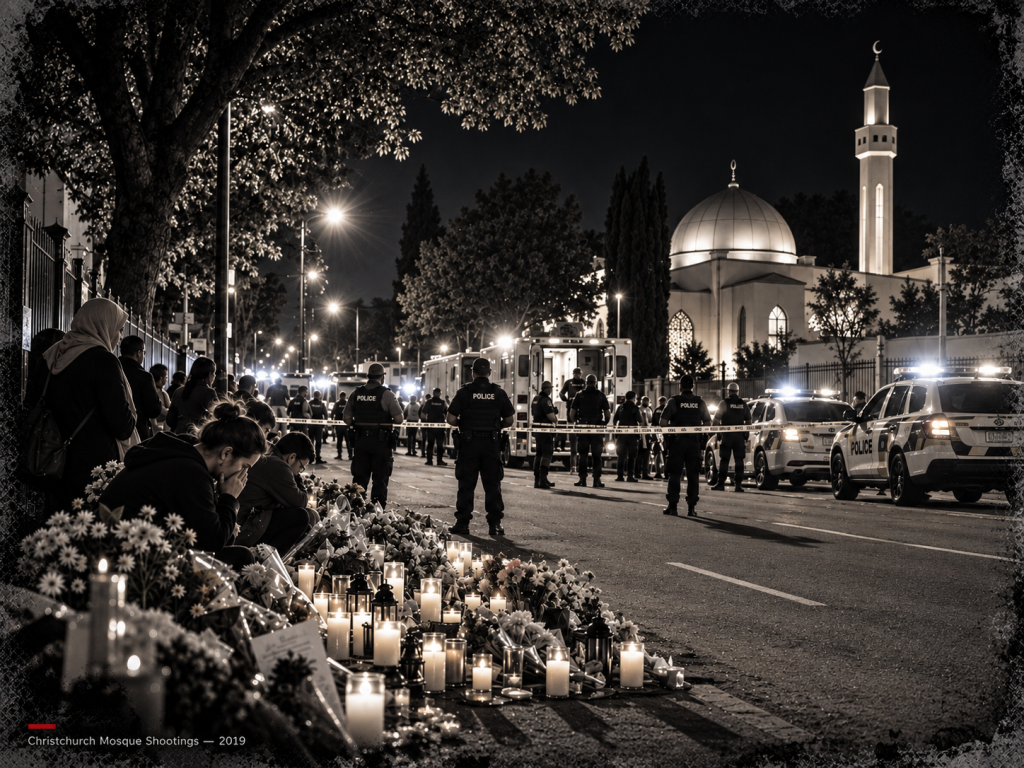
Friday 15 March 2019 was prayer time in Christchurch. At the Al Noor Mosque, and then at the Linwood Islamic Centre, a man with six firearms shot the people inside and the people trying to get out.
He was Brenton Harrison Tarrant, a 28-year-old Australian. He had arrived in New Zealand on 17 August 2017 and was living in Dunedin. The sentencing judge later recorded that he had no family there, had never sought work there, and had begun planning an attack before or shortly after he landed.
That morning he drove from Dunedin to Christchurch. Before he opened fire he emailed a document he called his manifesto to an extremist website, and sent threats, with the same document attached, to the government and to media organisations. He filmed the attack on a head-mounted camera and streamed it live on Facebook.
Fifty-one people were murdered and forty others were wounded in the attempt to murder them. The youngest of the dead was three years old.
What the court recorded
Tarrant pleaded guilty. On 27 August 2020, in the High Court at Christchurch, Justice Cameron Mander sentenced him for the murder of 51 people, the attempted murder of 40, and engaging in a terrorist act.
He was the first person convicted of terrorism in New Zealand. The sentence was life imprisonment without parole, the first time a New Zealand court had made that order. Justice Mander told him the purposes of the sentence were accountability, denouncement, deterrence and the protection of the community, and that no minimum term would meet them.
In 2025 Tarrant applied to withdraw his guilty pleas and go to trial, saying prison conditions had made his admissions involuntary. On 30 April 2026 the Court of Appeal dismissed the application, calling it "utterly devoid of merit". It noted that he had filed 505 days after the deadline.
Government Response
New Zealand, the same month
Ten days after the attack the government announced a Royal Commission of Inquiry, and within a month Parliament had changed the gun laws. The Arms Amendment Act passed by 119 votes to 1. It banned most semi-automatic firearms, the parts used to convert a firearm into a semi-automatic, and magazines over a set capacity.
On 20 June 2019 the government announced a buy-back. Finance Minister Grant Robertson and Police Minister Stuart Nash set aside NZ$208 million to compensate owners, up to 95 per cent of the original cost. The deadline to hand the prohibited firearms in was 20 December 2019.
On 23 March 2019 the Chief Censor, David Shanks, classified the document Tarrant had emailed as objectionable under New Zealand law. He called it a crude booklet that promotes murder and terrorism, and told anyone holding a copy to destroy it. Possession became an offence.
What the Royal Commission found
The report, Ko tō tātou kāinga tēnei — "This is our home" — was delivered to the Governor-General on 26 November 2020 and presented to Parliament on 8 December 2020. It runs to four volumes and makes 44 recommendations.
The commission found there was "no plausible way" Tarrant could have been detected except by chance, and that the fact he was not detected was not in itself an intelligence failure. The only alert in official hands was the email he sent to the Parliamentary Service at 1.32pm, eight minutes before he opened fire at Al Noor. It took minutes for that office to open it, read the attachment, and pass it to police.
It also found failures. New Zealand Police's administration of the firearms licensing system "did not meet required standards." He was granted a licence within about three months of arriving. The referees he nominated were a gaming friend and that friend's parent. The commission found insufficient attention was given to whether they knew him well enough. Police Commissioner Andrew Coster apologised for the licensing failures.
On the watch itself, the commission found that from 2016 to the day of the attack, counter-terrorism resources had been focused primarily on the threat of Islamist extremist terrorism. It called that concentration inappropriate and said it was not based on a comparative risk analysis. It also found that, until mid-2018, the Security Intelligence Service lacked the capacity to deal with that threat while also baselining others. Work on right-wing extremism had begun in May 2018.
Prime Minister Jacinda Ardern told reporters the commission made no finding that these failures would have stopped the attack, but she apologised for them anyway. "While the commission made no findings that these issues would have stopped the attack, these were failings nonetheless and, for that, on behalf of the government I apologise." The government agreed in principle to all 44 recommendations.
Australia
The man who did it was Australian. On 16 March 2019 Prime Minister Scott Morrison went to Lakemba Mosque in Sydney. Opposition leader Bill Shorten, at a mosque in Melbourne the same day, said: "It was an Australian who did this." He said Tarrant did not represent Australia.
The two countries had no prisoner-transfer arrangement, though Morrison said Australia was open to considering a request from New Zealand.
Australia was among the 17 countries that adopted the Christchurch Call, launched in Paris on 15 May 2019 by New Zealand and France, together with the major online platforms. The Call is a voluntary commitment to stop the internet being used the way it was on 15 March, when an attack planned online was streamed live. Norway signed the same text.
Summary
An Australian man drove from Dunedin to Christchurch on a Friday, murdered 51 people at two mosques and tried to murder 40 more. He filmed the attack and later pleaded guilty. A New Zealand court sentenced him to life in prison without parole, a sentence the country had never imposed before.
Parliament banned the class of firearm he used and paid owners to hand them in, and the censor banned his document. A Royal Commission found he could not plausibly have been detected except by chance. It also found that the firearms system had not met its own standards and that counter-terrorism resources had been inappropriately concentrated on one kind of threat. The Prime Minister apologised for the failures, while noting the commission had not found they would have stopped him.
The sentencing remarks and the Royal Commission report are both public documents.
You be the judge.