 7 OCT 2026
Nice Bastille Day Truck Attack
7 OCT 2026 Minto stabbing – Ihsas Khan
On 10 September 2016, Ihsas Khan stabbed his neighbour Wayne Greenhalgh, 57, many times with a hunting knife in a driveway in Minto, in Sydney's south-west. Mr Greenhalgh survived after running to a nearby hairdressing salon for help. SBS reported that Khan shouted "Allahu Akbar" during the attack, and the ABC reported that he was tasered, arrested and charged with committing a terrorist act. The jury accepted the prosecution case that he had planned to attack a civilian on or around 11 September, the anniversary of the 2001 attacks, and that he chose Mr Greenhalgh because of a T-shirt carrying a US stars-and-stripes and Iwo Jima flag-raising image.
Khan pleaded not guilty on the ground of mental illness. In May 2019, after a series of mistrials, the sixth jury to hear the case found him guilty. On 5 June 2019, Justice Geoffrey Bellew of the NSW Supreme Court sentenced him to 36 years' imprisonment, with a non-parole period of 27 years. The judge said: "The offender's attack was violent, ferocious and inhumane," and "The offender did not just set out to harm Mr Greenhalgh, he was on a mission to kill him." The ABC reported that Mr Greenhalgh has ongoing nerve damage, insomnia and post-traumatic stress disorder, and cannot work.
A 2020 paper by NSW Supreme Court Justice Peter Johnson records that R v Khan (No. 11) and R v Shoma (Vic) "were the first persons to be sentenced for the offence of intentionally engaging in a terrorist act, with sentence being passed coincidentally on the same day in the Supreme Courts of NSW and Victoria."
More sources:
7 OCT 2026 Christmas 2016 terror plot, Melbourne
On 22 December 2016, the Victorian Joint Counter Terrorism Team (AFP, Victoria Police and ASIO) arrested men it said had planned an attack in Melbourne's CBD. A joint AFP–Victoria Police release says the men planned "to use improvised bombs and machetes in a terrorist attack in Melbourne’s CBD during the 2016 Christmas period." Detectives from Operation Kastelholm seized machetes, partly built IEDs, and devices holding Islamic State propaganda and bomb-making instructions. The SMH reported that between October and late December 2016 the group bought chemicals and other materials from Bunnings and Chemist Warehouse, downloaded bomb-making instructions and tried to make IEDs. The ABC reported that the trial heard Federation Square was a planned target.
Ibrahim Abbas pleaded guilty and gave evidence that he was the ringleader. In September 2018, Justice Andrew Tinney sentenced him to 24 years with a 20-year non-parole period, although the sentence was not published until November 2018, after a suppression order was revoked. Justice Tinney said: “Your timely arrest by the dedicated and expert investigators of the Joint Counter Terrorism Team was all that prevented a devastating and murderous terrorist attack in the heart of the City of Melbourne.”
In October 2018, a jury found Hamza Abbas, Abdullah Chaarani and Ahmed Mohamed guilty of conspiring to do acts in preparation for, or planning, a terrorist act (s 101.6 Criminal Code (Cth)). On 29 November 2019, Justice Christopher Beale sentenced Hamza Abbas to 22 years (non-parole 16 years 6 months). Chaarani and Mohamed received new head sentences of 38 years (non-parole 28 years 6 months), because both were already serving terms for setting fire to a Shia mosque in Fawkner. Justice Beale called the plot "an assault on the fundamental values of our society".
More sources:
7 OCT 2026 Orlando Pulse nightclub shooting
Just after 2am on 12 June 2016, Omar Mir Seddique Mateen opened fire on staff and patrons at the Pulse nightclub in Orlando, Florida, where about 300 people were present. According to the FBI, an active-shooter situation became a hostage situation when he barricaded himself and victims in a bathroom, and officers killed him at about 5am. Forty-nine people were murdered and 58 wounded. In three 911 calls during the attack, he claimed allegiance to the leader of the so-called Islamic State, among others. The FBI states: "The FBI concluded the attack was an act of terrorism—the worst on U.S. soil since September 11, 2001." It also says the club building was demolished in March 2026, with a permanent memorial planned for 2027.
Mateen's widow, Noor Salman, was charged with providing material support to a terrorist organisation and with obstruction. A federal jury acquitted her of both on 30 March 2018. AP reported that the FBI's own receipts and cellphone data showed the couple were not near the Pulse on the day she said they had scouted it.
Prime Minister Malcolm Turnbull said: "This was a murderous attack on gay people in this nightclub" (SMH).
More sources:
7 OCT 2026 Berlin Christmas market attack
At 20:14 local time on 19 December 2016, a lorry loaded with steel beams was driven into the Christmas market at Breitscheidplatz, near the Kaiser Wilhelm Memorial Church in Berlin, killing 12 people and injuring 49 (BBC). The lorry's Polish driver, Lukasz Urban, 37, was found dead in the cab, and police said he appeared to have been the victim of a hijack. Police first detained a 23-year-old Pakistani man, who denied involvement and was released after questioning.
German prosecutors named Anis Amri, a 24-year-old Tunisian, as the driver after finding his identity papers in the cab, and his fingerprints were later found there too. The BBC reported that he was known to German authorities and had used several identities. His asylum claim had been rejected, but he could not be deported because he lacked valid identity papers. So-called Islamic State said one of its "soldiers" carried out the attack, without offering evidence. Amri was shot dead by Italian police near Milan on 23 December 2016 after he opened fire on officers during a routine check.
Brisbane woman Trisha O'Neill, who lived in Berlin, told the ABC she saw "blood and bodies everywhere" (reported by SBS and SMH). DFAT warned Australians to avoid the area and tried to find out whether any Australians were hurt. Prime Minister Malcolm Turnbull said Australia would do all it could to reduce the risk of attack here, but "we cannot mitigate all risk entirely" (SBS).
More sources:
Introduction
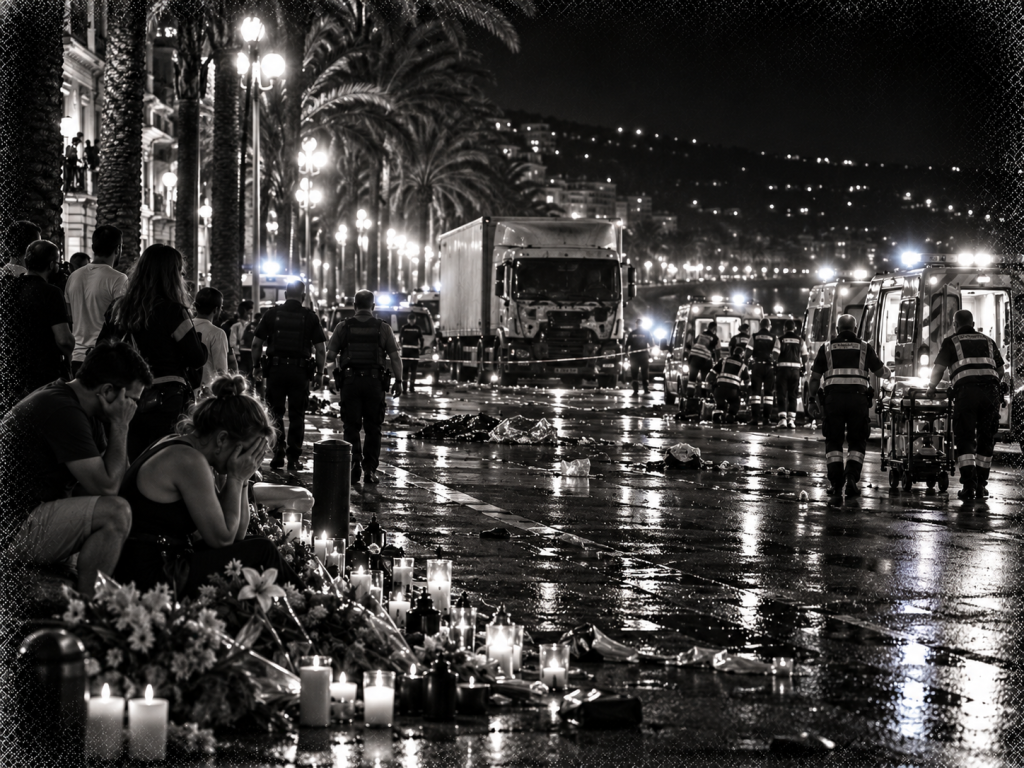
On 14 July 2016, Bastille Day, Mohamed Lahouaiej-Bouhlel drove a 19-tonne truck into people gathered on the Promenade des Anglais in Nice. The fireworks had finished, but thousands of people were still on the waterfront. He drove for almost two kilometres.
French official material records 86 people killed and more than 400 injured.
Police shot and killed him. Islamic State later claimed him as one of its soldiers, but French anti-terrorism investigators were unable to establish any link between him and the group beyond the claim.
In December 2022 a Paris court convicted eight people of helping him in varying ways. The longest sentences, 18 years, went to Mohamed Ghraeib and Chokri Chafroud.
Government Response
French anti-terrorism prosecutors opened an investigation immediately. Victim-assistance and national crisis structures were activated.
The attack came less than a year after the Paris attacks. It intensified the debate over security, intelligence and the state of emergency that had been in place since November 2015.
Australia
Foreign Minister Julie Bishop confirmed that three Australians were injured trying to flee the scene. Prime Minister Malcolm Turnbull said: "Only eight months ago we mourned for the victims of terrorist attacks in Paris. Now once again we mourn for the victims of another murderous act of terror in France."
Summary
On France's national day in 2016, a man drove a truck into the crowd on the Promenade des Anglais in Nice, killing 86 people and injuring more than 400. Police shot him dead. Islamic State claimed him, although investigators could not establish a link beyond the claim. Eight people were later convicted of helping him.
It was a public celebration, not a military or government target, and it came after a run of attacks on crowds, venues and ceremonies in France.
You be the judge.