 7 OCT 2026
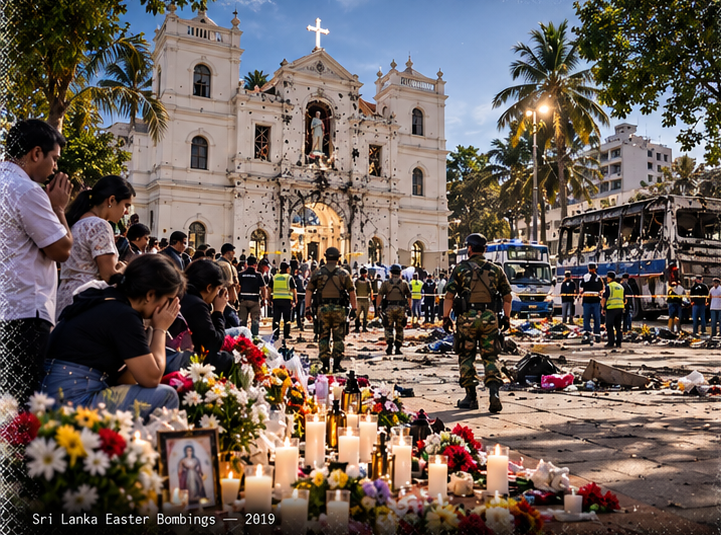
Sri Lanka Easter Bombings
7 OCT 2026 Islamic State leader al-Baghdadi killed
Abu Bakr al-Baghdadi, the leader of Islamic State, died during a night raid by US special operations forces on a compound in Syria's north-western Idlib province. President Donald Trump announced the death at the White House on 27 October 2019. In the official record of his remarks he said: "Last night the United States brought the world's number-one terrorist leader to justice. Abu Bakr al-Baghdadi is dead."
Trump said al-Baghdadi fled into a dead-end tunnel with three of his children and "ignited his vest, killing himself and the three children". He said test results gave positive identification. AP reported that Defense Secretary Mark Esper said two US service members suffered minor injuries. National security adviser Robert O'Brien said the remains would be buried at sea.
On 28 October 2019, Prime Minister Scott Morrison, Foreign Minister Marise Payne and Defence Minister Linda Reynolds issued a joint statement. It said al-Baghdadi "inspired or directed cowardly attacks by ISIS followers against innocent civilians around the world, some of whom were Australian." It also said "his death does not represent the end of the campaign to defeat this terrorist group". The statement confirmed that Australian Defence Force personnel continued to support Coalition operations against ISIS.
More sources:
Introduction
What happened
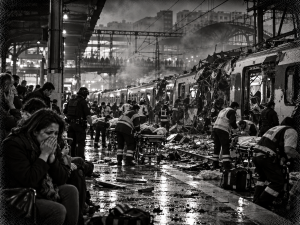
On Easter Sunday, 21 April 2019, suicide bombers attacked three churches and three luxury hotels in Sri Lanka.
The first reports came at about 08:45 local time. Six blasts followed within a short space of time BBC News. The churches were in the Kochchikade district of Colombo, in Negombo north of the capital, and in the eastern city of Batticaloa. The hotels were the Shangri-La, the Kingsbury and the Cinnamon Grand in Colombo BBC News.
Later that day there were two more explosions as police searched for suspects, one in Dehiwala and one near Dematagoda. Three police officers were killed at Dematagoda BBC News.
Death toll
The official figures changed during the first week. The toll reached 359. The health ministry then revised it down to "about 253", blaming a calculation error and the difficulty of identifying victims BBC News.
Sri Lanka's Parliamentary Select Committee later reported that the bombings "killed around 277 people (including 8 suicide bombers) and wounded more than 400 people as per the information provided by Police Headquarters". It also reported that "At least 40 foreign nationals and at least 45 children were reported to be among the dead" Parliament of Sri Lanka, Select Committee Report. The US Justice Department used a figure of 268 dead, including five US citizens US Department of Justice.
Who was responsible
Sri Lankan authorities blamed a local Islamist group, National Thowheed Jamath (NTJ). Two days after the attacks, the Islamic State (IS) group said it had carried them out and released a video of men it said were the bombers, pledging allegiance to IS BBC News.
The Select Committee wrote: "Investigators identified Zahran Hashim, one-time leader of the National Thowheed Jamaath, as the main suspect behind the execution of these co-ordinated attacks". It also wrote that "investigations to date have not shown any evidence that Zahran had direct links with the ISIS" Parliament of Sri Lanka, Select Committee Report. A US criminal complaint said the attackers' group called itself "ISIS in Sri Lanka" US Department of Justice. The Select Committee counts eight bombers among the dead. The BBC reported nine BBC News.
Australian victims
Two Australian citizens, Manik Suriaaratchi and her 10-year-old daughter Alexendria, were killed when a bomb exploded in a church in Negombo ABC News. Two other Australians were injured Australian Minister for Foreign Affairs. Officials told the BBC that at least one of the bombers "had spent time abroad in the UK and Australia" BBC News.
Government Response
Sri Lanka, the same days
The government imposed a curfew and restricted access to social media BBC News. The president's office declared a state of national emergency from midnight on 22 April, giving police and the military wide powers to detain and question suspects without court orders BBC News. The emergency stayed in place for four months The Guardian. The NTJ was banned.
The government admitted a "major intelligence lapse" because an Indian intelligence warning had not been properly shared. President Maithripala Sirisena moved to sack the defence secretary and the police chief BBC News.
What the Select Committee found
The Select Committee held 24 sittings, heard 55 witnesses and presented its report on 23 October 2019. It found that "the Director SIS bears the greatest responsibility". It also found that the President "failed in numerous occasions to give leadership and also actively undermined government and systems including having ad hoc NSC meetings and leaving out key individuals from meetings" Parliament of Sri Lanka, Select Committee Report.
In February 2021 a presidential commission of inquiry recommended that Sirisena and senior intelligence staff be prosecuted The Guardian.
What the courts did
On 12 January 2023 the Supreme Court ordered that "The former President, Mathripala Sirisena is ordered to pay a sum of Rs 100 million as compensation". It also ordered payments from the former police chief, the former intelligence chiefs, the former defence secretary and the State Supreme Court of Sri Lanka. The court said: "This dismal failure on the part of former President Sirisena resulted in disastrous consequences for this country" AP.
Former police chief Pujith Jayasundara and former defence secretary Hemasiri Fernando were acquitted in 2022. After the Supreme Court ordered a retrial, a High Court majority sentenced both to death in July 2026. Sri Lanka has not carried out an execution since 1976 ABC News AP.
The trial of 25 men began in November 2021, on more than 23,000 charges The Guardian. On 22 September 2026 the High Court sentenced 15 men to prison terms of 200 to 260 years each, including Naufer Moulavi, whom prosecutors called the mastermind. Nine men were acquitted BBC News.
Former intelligence chief Suresh Sallay was arrested in February 2026 and denies the allegations BBC News. Police said investigators were looking at possible "links or lapses" AP. No court finding against him has been made.
United States and Australia
In January 2021, US prosecutors charged three Sri Lankan men with conspiring to provide material support to ISIS US Department of Justice.
In a joint statement on 22 April 2019, the Australian Foreign Minister and Prime Minister said: "Australia stands with the people of Sri Lanka as they continue to come to terms with this senseless and barbaric attack. The Australian Government utterly condemns all acts of terrorism and violence." They also changed Australian travel advice for Sri Lanka to "Reconsider your need to travel" Australian Minister for Foreign Affairs.
Summary
On 21 April 2019, coordinated suicide bombings hit three churches and three hotels in Sri Lanka BBC News. Sri Lanka's Parliament put the toll at around 277 dead including eight bombers, with more than 400 wounded Parliament of Sri Lanka. Two Australians, a mother and her 10-year-old daughter, died in Negombo ABC News.
Sri Lankan authorities blamed National Thowheed Jamath, and Islamic State claimed the attacks BBC News. Sri Lanka's own inquiry found that warnings had reached the intelligence chief more than two weeks before the attacks, and that he bears the greatest responsibility for the failure to act Parliament of Sri Lanka. The Supreme Court ordered a former president to pay compensation from his own funds Supreme Court of Sri Lanka. Two former security chiefs were sentenced to death for criminal negligence AP, and 15 men were convicted more than seven years after the attacks BBC News. Investigations were still continuing in 2026, including into a former intelligence chief who denies the allegations BBC News. US prosecutors filed their own charges against three alleged members of the group US Department of Justice. The Australian Government condemned the attacks and changed its travel advice Australian Minister for Foreign Affairs.
The Select Committee report is a public document. The Supreme Court order is a public document. You be the judge.