 7 OCT 2026
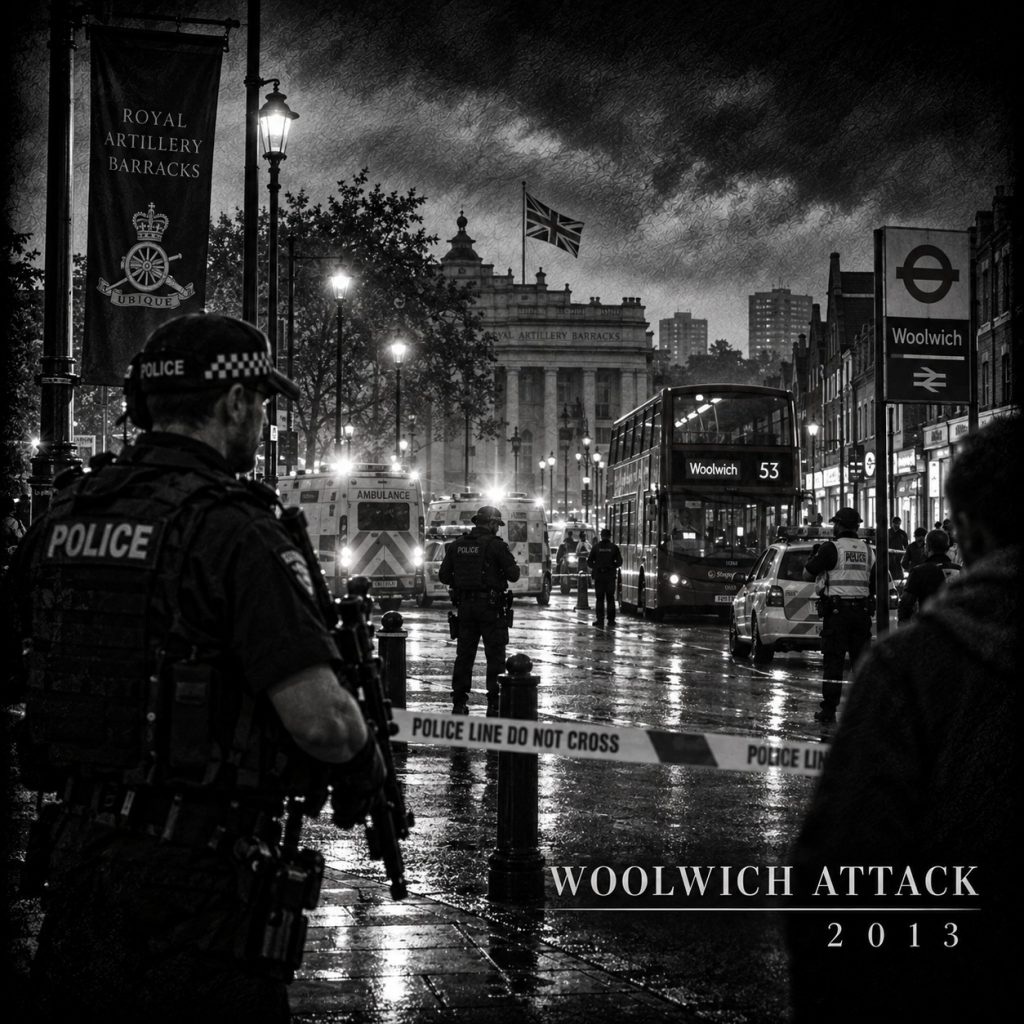
The Woolwich Attack
7 OCT 2026 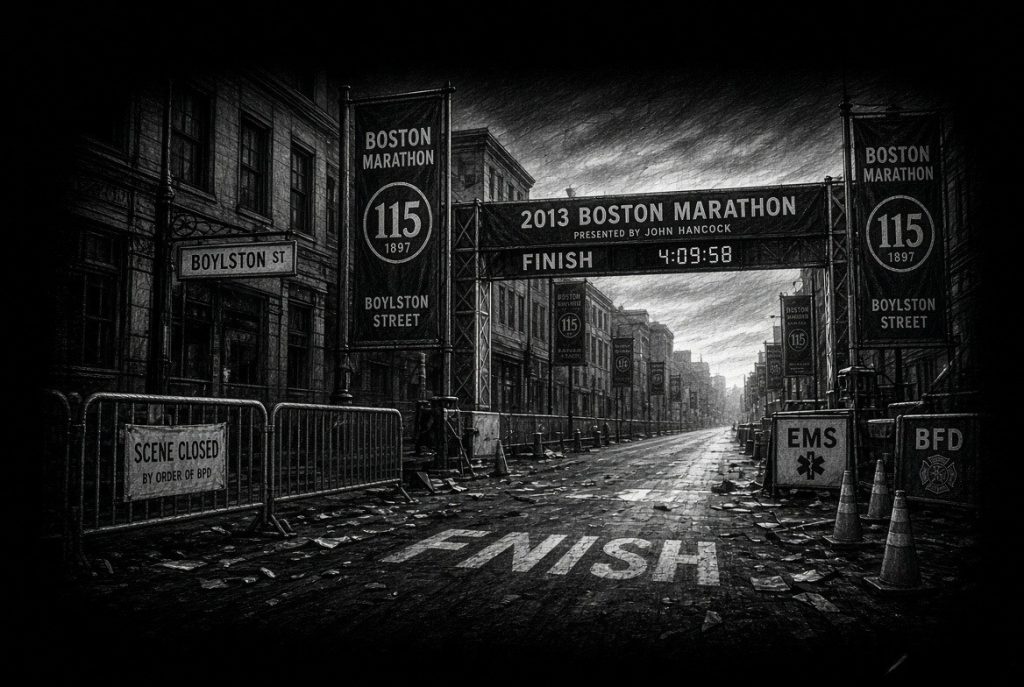
Boston Marathon Bombing
The US Department of Justice says that on 15 April 2013, during the 117th Boston Marathon, brothers Dzhokhar and Tamerlan Tsarnaev "placed two pressure cooker bombs filled with shrapnel among the crowds of spectators on Boylston Street and then detonated the bombs seconds apart, killing three people, maiming 17, and injuring hundreds more." The BBC gives the number wounded as 260. Two of those killed were Lingzi Lu and Martin Richard.
On 18 April the brothers shot and killed MIT Police Officer Sean Collier, then carjacked an SUV and exchanged fire with police in Watertown, where Tamerlan Tsarnaev died. Dzhokhar was found hiding in a boat in a Watertown backyard and arrested the following night (DOJ).
A federal jury convicted Dzhokhar Tsarnaev on all 30 counts on 8 April 2015 and recommended the death penalty on 15 May 2015. Judge George A. O'Toole Jr. imposed the death sentence on 24 June 2015 (DOJ). A federal appeals court vacated the death sentence in July 2020. On 4 March 2022 the US Supreme Court reinstated it by six votes to three (BBC).
More sources:
7 OCT 2026 Westgate Mall attack, Nairobi
At about midday on Saturday 21 September 2013, gunmen stormed the Westgate shopping centre in Nairobi, throwing grenades and firing automatic weapons. The Somali group al-Shabab claimed the attack, saying it was a response to Kenyan troops in Somalia. After a four-day siege, President Uhuru Kenyatta said 61 civilians and six members of the security forces had died, five attackers had been killed and 11 suspects were in custody. He called the toll provisional because three floors of the mall had collapsed.
Tasmanian-born architect Ross Langdon, who held Australian and UK citizenship, was killed along with his partner Elif Yavuz, who was eight and a half months pregnant. DFAT confirmed that one Australian citizen had been killed. Several Australians escaped, including lawyer Heidi Edwards, who described fleeing through a staff door. Acting Foreign Minister Andrew Robb said: "The Australian Government has condemned this brutal terrorist attack in the strongest possible terms". Consular staff contacted Australians living in Nairobi and advised them to take extreme caution.
In October 2020 a Kenyan court convicted Mohammed Ahmed Abdi and Hussein Hassan Mustafa of helping the attackers and acquitted a third man. The BBC reported sentences of 33 and 18 years. AP reported 26 and 11 years, noting the court took into account the seven years they had already spent in custody.
More sources:
7 OCT 2026 Shady Alsuleiman sermon after the Gaza delegation: “The Gaza Strip”
This is a Friday sermon by Sheikh Shady Alsuleiman, president of the Australian National Imams Council, given in Sydney after he returned from a delegation of Australian imams and community leaders to Egypt, Gaza and Jordan. The delegation, led by the Mufti of Australia, met Hamas leader Ismail Haniyeh in Gaza on 26 December 2012 (ABC).
He opens (3:36): "Two weeks ago, I spoke to you from this minbar and I mentioned to you that Allah subhanahu wa ta'ala had blessed me ... and other imams and mashayikh and community leaders [to travel to] Gaza, Egypt and Jordan, and alhamdulillah, we arrived yesterday night after one of the most beautiful journeys that I had ever experienced in my life." The earliest copy found online was uploaded on 5 February 2013. The exact date of the sermon is not stated; from his own words, it was given in early January 2013.
On meeting Hamas (18:40): "Yes, we met with some of the leaders there, and you probably all aware that the Gaza Strip is led by Hamas, and Hamas to some of the countries is a terrorist organization, but by the way in Australia it's not." (At the time, Australia listed only Hamas's armed wing, the Izz al-Din al-Qassam Brigades, listed since 2003. Hamas as a whole was listed on 4 March 2022.)
On the people he met (23:48): "I felt pride when I was there ... I felt that I was proud Muslim to be amongst true men ... They fear no one except Allah, they fear no attacks, they fear no war."
(25:14): "You see it from a father who says that one of my children died and I've got three other more ready to die. You see that mother that says that two of my children passed away for the sake of Allah and I've got another two more ready to die for the sake of Allah. You see that pride and you see the honor."
The sermon is in English, with opening and closing prayers in Arabic. Transcribed by The Evidence Project.
More sources:
Introduction
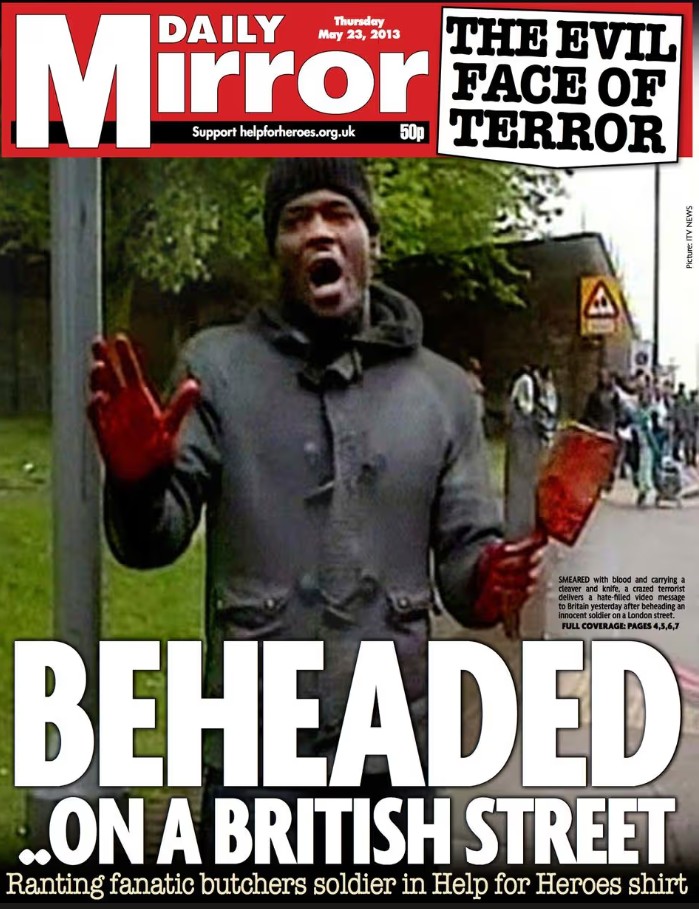
On 22 May 2013, in daylight, Michael Adebolajo and Michael Adebowale murdered Fusilier Lee Rigby on a street in Woolwich, London. Rigby was off duty and walking near the Royal Artillery Barracks. They struck him with a vehicle and attacked him with bladed weapons.
The attackers did not flee. While Rigby lay in the road, one of them spoke to witnesses and cameras. Images of the killing, and the attacker's own explanation, reached the public almost as it happened.
Police confronted and shot both men, who survived and were prosecuted. Both were convicted of murder on 19 December 2013 and sentenced to life imprisonment on 26 February 2014, Adebolajo with a whole life order and Adebowale with a minimum of 45 years.
What the court found
Sentencing the two men, Mr Justice Sweeney said they had decided "to murder a soldier in public in broad daylight and to do so in a way that would generate maximum media coverage", expecting to be shot by armed police and to "become martyrs". Lee Rigby, 25, had joined the army in 2006, served in Afghanistan in 2009 and was working in recruitment. He was recognisable as a soldier because he was wearing a "Help for Heroes" top.
The judge found they ran him down from behind at 30 to 40 mph, then for two to three minutes attacked him with knives and a cleaver, Adebolajo trying to behead him "for maximum horrific effect". They dragged his body into the road and waited for police. Adebolajo, holding the bloodied cleaver and knowing he was being filmed, made a statement that the judge said sought to justify the murder "as being retaliation for deaths in Muslim lands, and to incite the removal of the Government in this country". In the footage, broadcast around the world, he told onlookers: "You people will never be safe. Remove your governments, they don't care about you."
The judge contrasted the killers' conduct with "the compassion and bravery shown by the various women at the scene who tended to Lee Rigby's body and who challenged what you had done and said."
Why it mattered in Australia
The method - a random person killed in public, on camera, to frighten a whole country - reached Australia sixteen months later. In September 2014 police said an Australian ISIS recruiter, Mohammad Ali Baryalei, had phoned a Sydney man with instructions to seize a random member of the public and behead them on video. The plot was stopped by the largest counter-terrorism raids in Australia's history.
Government Response
Both men had previously come to the attention of the security services.
Parliament's Intelligence and Security Committee conducted a detailed inquiry into the intelligence relating to the murder. Its November 2014 report concluded that, given what the agencies knew at the time, they were not in a position to prevent it. It separately criticised an unnamed internet company for not flagging a December 2012 online exchange in which Adebowale spoke of killing a soldier. Committee chairman Sir Malcolm Rifkind said that had MI5 seen it, "there is then a significant possibility that MI5 would have been able to prevent the attack."
In Australia, the killing and the inquest were reported by the ABC. The British government's response addressed the intelligence history and broader questions about online extremist communications and radicalisation.
Summary
On 22 May 2013, two men ran down and killed Fusilier Lee Rigby near his barracks in Woolwich, then spoke to cameras while he lay in the road. Both were convicted of murder and given life sentences.
Both had been known to the security services. The Intelligence and Security Committee found the agencies could not have prevented the killing on what they knew, and criticised an internet company for not flagging an earlier online exchange about killing a soldier.
Public grief for Rigby sat alongside fears of retaliatory attacks on Muslims and mosques.
You be the judge.