 7 OCT 2026
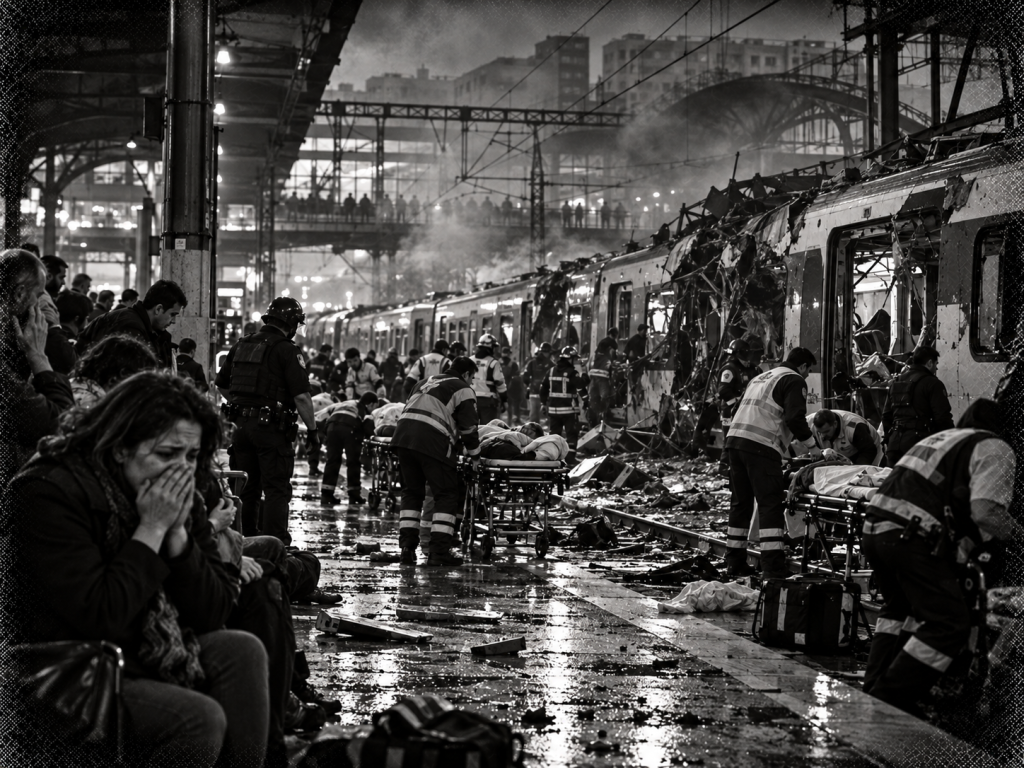
Madrid Train Bombings
7 OCT 2026 Australian Embassy bombing, Jakarta
On 9 September 2004, a suicide bomber set off a one-tonne bomb hidden in a truck outside the Australian Embassy in Jakarta. The Australian Federal Police say it was "the first deadly attack on an Australian diplomatic mission". The AFP says 10 people were killed on the day and more than 200 were injured, and that "all 10 victims were Indonesian citizens, including locally contracted staff who worked at the Embassy". Foreign Minister Penny Wong said in 2024 that the dead included 3 locally contracted staff of the mission.
Australia's response: under Operation Bantu, Australian investigators, forensic, technical and intelligence specialists supported the Indonesian National Police. The AFP says plastic pellets from the bomb's boxes helped link the attack to Jemaah Islamiyah members Noordin Mohammad Top and Azahari Husin. Both were later killed when Indonesian police tried to arrest them.
The attack came during Australia's federal election campaign, ahead of the 9 October 2004 poll. Foreign Minister Alexander Downer said: "You would have to conclude that it was directed towards Australia". Prime Minister John Howard said: "This is not a nation that is going to be intimidated by acts of terrorism." The Guardian reported that the injured included Australian nationals and that Australia advised citizens to defer non-essential travel to Indonesia.
More sources:
7 OCT 2026 Hilali’s ‘September 11 is God’s work’ sermon
Sheik Taj el-Din al-Hilaly was based at the Lakemba mosque in Sydney. During a Middle East lecture tour he gave a sermon at the Sidon mosque in Lebanon, and the Sun-Herald obtained a translation of it which quoted him as saying: "September 11 is God's work against oppressors." The same translation quoted him referring to "a civilian airplane whose secrets cannot be explained" and asking "the giant that fell: 'Who humiliated you?'" The report added that "A week ago, the Australian Federal Police decided against investigating the Mufti's overseas activities."
On 29 February 2004 Foreign Minister Alexander Downer told Channel Nine that he had read a transcript of the speech. The ABC reported that he said the speech supported suicide bombings and described the September 11 attacks as God's work against oppressors. Downer said: "For an Australian to go overseas and make these sorts of comments is appalling, it's provocative." He also said: "it doesn't reflect the views of Muslims here in Australia".
Hilaly's spokesman Keysar Trad (spelled Kayser Trad by the ABC) said the Mufti had taken bits from poems. Trad said the reference meant "evil can reach everywhere and everything". The ABC quoted him saying: "He has always condemned and continues to condemn any attacks against civilians." In March 2004 Hilaly wrote to Prime Minister John Howard and other leaders. He said: "As for the claim that I referred to the tragic events of September 11 as 'God's work against oppressors', this is a terrible mistranslation." The same month he issued a statement saying any attack on Australia would be "an act of stupidity, recklessness and madness".
More sources:
7 OCT 2026 Beslan school siege
On 1 September 2004, at about 9.30am local time, masked armed men and women wearing bomb belts stormed School Number One in Beslan, North Ossetia, Russia, on the day of a ceremony marking the start of the school year. The BBC timeline says hostages were forced into the school gym and the building was reportedly mined. Officials first estimated 330 hostages, but released hostages later told Russian media that more than 1,000 people might be held. The hostage-takers demanded that Russian troops be withdrawn from Chechnya.
On 3 September, at about 1pm, two loud explosions were heard, followed by heavy sustained gunfire, and Russian special forces stormed the school. BBC Newsnight later reported that 326 people died, 186 of them children. It also reported that only one attacker was jailed and "not a single official found responsible for the attack".
Australian response: the ABC reported that Prime Minister John Howard sent a message of sympathy and condolence to President Vladimir Putin. Howard said: "I think there's a commonality in the obscene indiscriminate indifference, in such a cruel way, to human life." Opposition Leader Mark Latham said: "What sort of people go out of their way to hurt children?" Foreign Minister Alexander Downer said Australia would consider sending a small group of Australian Federal Police with terrorism experience. Russia's ambassador, Leonid Moiseev, said the Canberra embassy had been inundated with calls and emails from Australians. Howard said the local Russian Orthodox community was raising resources.
More sources:
7 OCT 2026 Theo van Gogh murdered, Amsterdam
Dutch film-maker Theo van Gogh, 47, was stabbed and shot dead while cycling in Amsterdam on 2 November 2004. Police arrested a 26-year-old man with joint Dutch and Moroccan nationality in a nearby park after an exchange of gunfire in which the suspect and a police officer were both wounded. Van Gogh had received death threats after his film Submission, made with Somali-born politician Ayaan Hirsi Ali and portraying violence against women in Islamic societies, was shown on Dutch TV. Prime Minister Jan Peter Balkenende said "it is unacceptable if expressing your opinion would be the cause of this brutal murder".
On 26 July 2005 an Amsterdam court sentenced Mohammed Bouyeri to life in prison without parole, ruling that the murder was a terrorist act. The BBC reported that the killer slashed van Gogh's throat and used a knife to pin a letter to his chest that threatened Ayaan Hirsi Ali. Holding a copy of the Koran, Bouyeri told the court that "the law compels me to chop off the head of anyone who insults Allah and the prophet". The BBC also reported that after the murder, mosques in several Dutch cities were vandalised or targeted in failed arson attempts.
More sources:
Nick Berg beheaded on video, Iraq
Nicholas Berg, 26, was a private businessman from Pennsylvania who had gone to Iraq looking for contracts. His body was found by the side of a road near Baghdad. On 11 May 2004 an al-Qaeda-related website posted a video titled "Abu Mussab al-Zarqawi slaughtering an American". The ABC reported that one of five hooded men read a statement denouncing the abuse of Iraqi detainees by US soldiers at Abu Ghraib prison, and that Berg was then beheaded. The ABC also reported it remained unclear whether Zarqawi personally carried out the killing.
US President George W Bush said there was no justification for the beheading, or for releasing the footage on the internet (ABC).
Australian angle: Australia had troops in Iraq at the time. No Australian government statement on Berg's killing was found in ABC reporting, which covered it as overseas news. Later that year Foreign Minister Alexander Downer called the beheading of British hostage Ken Bigley "barbaric" (ABC, 9 October 2004).
More sources:
Introduction
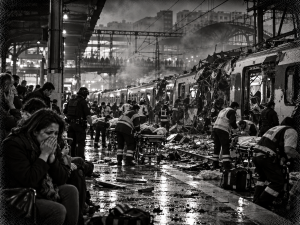
On the morning of 11 March 2004, in the rush hour, bombs exploded on four commuter trains heading into central Madrid. It was three days before Spain's general election.
The Spanish Government's own account states that the ten bombs on four trains killed 192 people and injured 2,084 travellers. It also records a further victim who died later from injuries, and a police officer of the Special Operations Group, Francisco Javier Torronteras, who was killed on 3 April 2004 when members of the cell blew themselves up in a flat in Leganes. Earlier and some international sources use 191, and others 193.
Spain had lived for decades with ETA terrorism, and early official attention focused heavily on ETA. The investigation instead established responsibility within a jihadist extremist network. On 31 October 2007 Spain's national court, the Audiencia Nacional, convicted 21 people and acquitted seven. Jamal Zougam, convicted of placing bombs, was sentenced to more than 40,000 years, although Spanish law limits time served to 40 years. Emilio Suárez Trashorras, who supplied the explosives, was also convicted.
Government Response
The attacks came days before the national election. As evidence pointed elsewhere, the government's initial emphasis on ETA became politically explosive. Large demonstrations followed, with protesters demanding accurate information from the government.
At European level, Madrid accelerated counter-terrorism coordination. The European Union made 11 March its day of remembrance for victims of terrorism, and adopted further counter-terrorism measures after the attacks.
Summary
On 11 March 2004, ten bombs on four Madrid commuter trains killed 192 people and injured more than 2,000. Early official attention went to ETA. The investigation found a jihadist network responsible, and in 2007 a Spanish court convicted 21 people.
Three days later Spain voted, after demonstrations demanding the truth about who was responsible.
You be the judge.