 7 OCT 2026
7 July London Bombings
7 OCT 2026 Bali bombings II
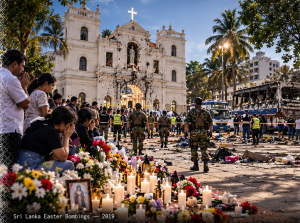
At about 7.30pm Bali time on 1 October 2005, three suicide bombers attacked restaurants in Kuta Square and at Jimbaran Bay in quick succession. Australia's Foreign Minister later confirmed 20 dead: four Australians, fifteen Indonesians and one Japanese national. Seventeen Australians were injured. Early reports gave higher death tolls of 24 to 32, which were later revised.
The four Australians killed were 16-year-old Brendan Fitzgerald of Busselton, WA, and Jennifer Williamson, 48, and Colin and Fiona Zwolinski, all from Newcastle, NSW. They were named by The Age/AAP and the ABC. The ABC reported that about 50 people from Newcastle had been holidaying in Bali, and that Williamson and the Zwolinskis were sitting at one table at Jimbaran Bay.
Australian response: the Australian Institute for Disaster Resilience records that two RAAF aircraft and four other emergency flights evacuated 17 Australians. An emergency response team arrived on 2 October with staff from DFAT, the AFP, Defence, Centrelink and Emergency Management Australia, and the AFP sent disaster victim identification experts, bomb experts and investigators. The Age reported that DFAT received about 3,500 calls and Qantas put on three relief flights. Howard called the bombers cowards who had shown blind hatred (The Age, paraphrased).
On the 20th anniversary, 1 October 2025, memorial services were held in Newcastle and Bali. Foreign Minister Penny Wong announced that the government would fund a permanent memorial in Australia.
More sources:
7 OCT 2026 Douglas Wood – Australian hostage in Iraq
Douglas Wood was an Australian engineer living in the United States. In late April 2005 he was abducted in Iraq by a group calling itself the Shura Council of the Mujahideen of Iraq. His capture became public on 1 May 2005, when the group released a video of him pleading for his life and asking Australian and US troops to leave Iraq. The kidnappers demanded that Australia withdraw its 1,400 troops. The government refused and instead sent a team of diplomats, police and military personnel to Baghdad to work for his release.
On 15 June 2005 Prime Minister John Howard told Parliament: "I am delighted to inform the House that the Australian hostage in Iraq, Mr Douglas Wood, is safe." Howard said the rescue was "conducted by Iraqi forces in cooperation in a general way with force elements of the United States". He also said no ransom was paid.
Nick Warner, who led the Australian emergency response team, told the ABC's 7.30 Report that an Iraqi military unit, in a sweep-and-cordon operation in the Gazalia area of Baghdad, found Wood and an Iraqi hostage and detained two guards. Warner said Wood had been held for 47 days, blindfolded and handcuffed for most of that time and fed little more than bread and water.
A spokesman for the Wood family, Neil Smail, said the family thanked the Australian Government, agencies in Iraq, and Sydney-based cleric Sheikh Taj El-Din Al-Hilaly for their efforts.
More sources:
7 OCT 2026 Anti-Terrorism Act (No. 2) 2005 – control orders
The Anti-Terrorism Bill (No. 2) 2005 was a Howard government bill from the Attorney-General's portfolio. It was introduced in the House of Representatives on 3 November 2005 and passed the House on 29 November. It passed the Senate on 6 December with 74 government amendments. The House agreed to the Senate amendments on 7 December, and the bill received Royal Assent on 14 December 2005 as Act No. 144 of 2005. The Parliament's bill summary lists its main measures:
- control orders and preventative detention orders in the Criminal Code (Schedule 4 of the Act)
- an expanded definition of terrorist organisation
- new terrorism financing offences
- wider stop, question and search powers
- updated sedition offences
- video surveillance at major airports
- stronger ASIO powers
The Age reported that the Senate passed the bill 53 to 7 after the government cut short debate. Labor voted in favour and the Greens and Democrats voted against. Greens leader Bob Brown told the Senate: "We are in a new period of McCarthyism and we need to know that". The Age reported that control orders could last up to 12 months.
The first control order was imposed on Melbourne man Jack Thomas in August 2006, days after the Victorian Court of Appeal had quashed his convictions. The Federal Magistrates Court in Canberra granted an interim order requiring him to stay home between midnight and 5am, report to police three days a week and not leave Australia without permission. Attorney-General Philip Ruddock said the order was about "protecting the Australian community, not punishing the person for an offence".
The control order regime is still in force. The Counter-Terrorism Legislation Amendment Bill 2026, introduced on 12 August 2026, would extend the control order and preventative detention frameworks to 7 December 2029. A parliamentary joint committee is reviewing it.
More sources:
7 OCT 2026 Danish Muhammad cartoons published
On 30 September 2005 the Danish newspaper Jyllands-Posten published 12 drawings of the Prophet Muhammad. In the paper's own account, it had asked Danish illustrators to draw the prophet "as a contribution to the debate about self-censorship". This followed a Danish author's difficulty finding an illustrator for a children's book about the prophet. The BBC reports that one drawing shows Muhammad with a lit bomb in his turban.
Jyllands-Posten says threats were made against the illustrators straight after publication, and the people who made them were arrested. On 19 October 2005, eleven ambassadors from Muslim countries asked to meet the Danish Prime Minister, who declined on the grounds that the Danish media is governed only by the courts. The BBC dates the ambassadors' complaint 20 October. In November and December a delegation of Danish imams toured the Middle East, taking with them, according to the paper, other offensive drawings that had never appeared in Jyllands-Posten.
The paper published an apology for offence on 30 January 2006, but has not apologised for publishing the drawings. It said: "they have indisputably offended many Muslims for which we apologise". The violent protests followed in early 2006 (see the next entry).
Australian reaction began in February 2006 and is covered in the next entry.
More sources:
Introduction
On the morning of 7 July 2005, four suicide bombers attacked London's public transport system during the rush hour. The day before, London had learned it would host the 2012 Olympic Games.
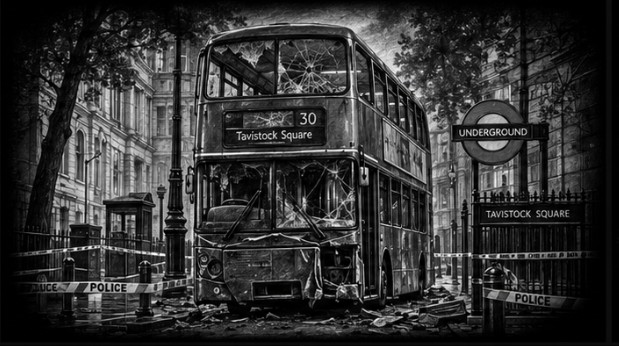
Three bombs exploded on Underground trains, and a fourth on a bus at Tavistock Square.
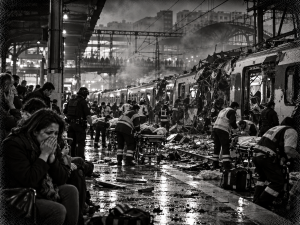
Fifty-two victims were killed, in addition to the four bombers, and hundreds were injured. At first the reports looked like transport emergencies, with explosions, smoke, trains stopped in tunnels and stations closing.
The attackers were British residents.
Melbourne man Sam Ly, who was on the bus at Tavistock Square, died of his injuries a week later. Other Australians were among the injured.
Government Response
The Intelligence and Security Committee examined the attackers' prior contact with the security system and the intelligence picture before the bombings.
The government produced an official account of the attacks.
In May 2011, inquests led by Lady Justice Hallett found the 52 victims were unlawfully killed. She found any suggestion that MI5 could have stopped the attacks was "based to a considerable extent on hindsight", but criticised some lapses by MI5 and the emergency services, and made nine recommendations.
The London Assembly separately examined emergency planning, communication and how the agencies performed on 7 July.
The bombings drove further debate about domestic radicalisation, intelligence priorities, emergency communications and terrorism legislation.
Summary
On 7 July 2005, four British suicide bombers attacked three Underground trains and a bus in London. Fifty-two people were killed and hundreds were injured.
Stations closed and telephone networks were overwhelmed. Families tried to find people, while news organisations tried to work out which incidents were connected.
The Intelligence and Security Committee and the London Assembly examined the intelligence and the emergency response. Muslim communities feared retaliation and collective blame.
You be the judge.