 7 OCT 2026
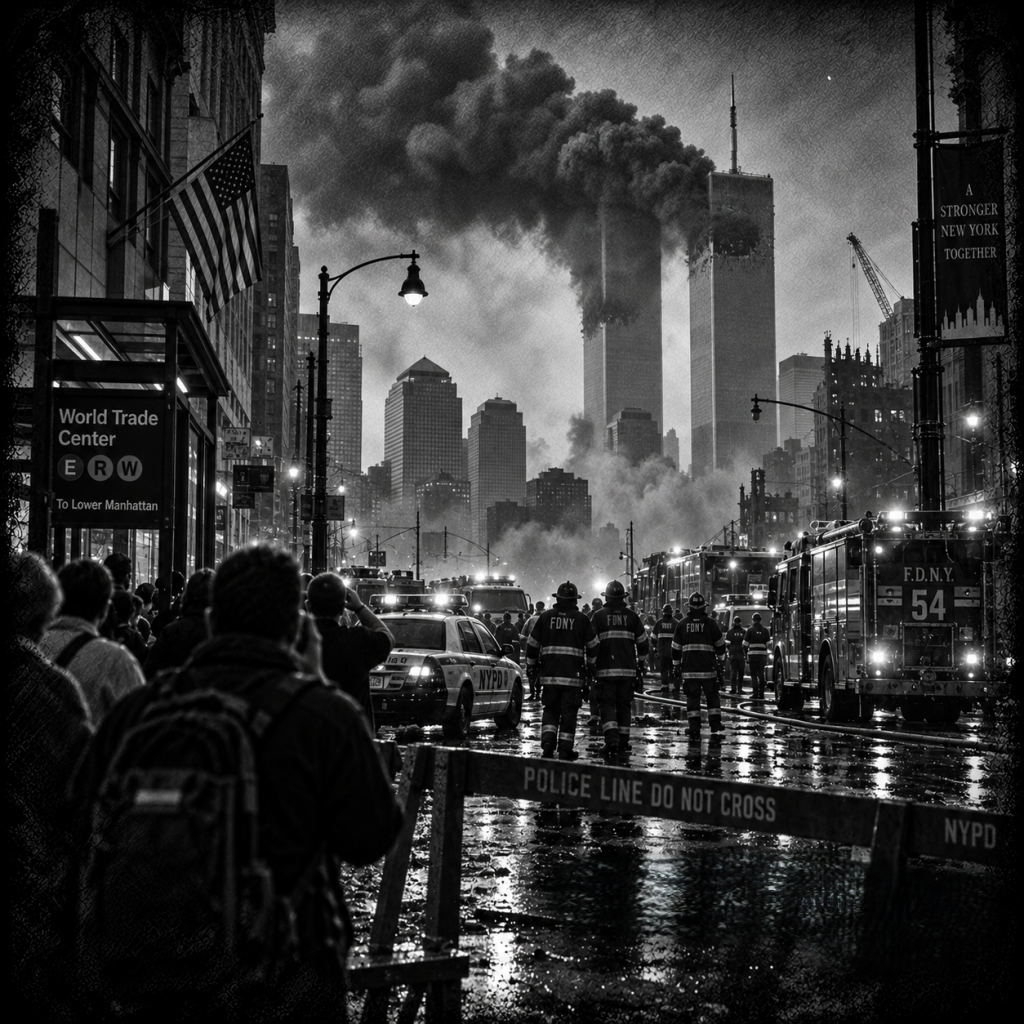
September 11 attack
7 OCT 2026 Anthrax mail
Soon after the 11 September 2001 attacks, letters containing anthrax began turning up in the US mail. The FBI says: "Five Americans were killed and 17 were sickened in what became the worst biological attacks in U.S. history." The FBI's investigation was code-named "Amerithrax". In August 2008 the Department of Justice and the FBI said charges were about to be brought against Dr Bruce Ivins, a scientist at a US Army laboratory, but he took his own life before they could be filed. The investigation was formally closed on 19 February 2010.
Australia had a large number of hoaxes and scares at the same time. The Commonwealth Chief Medical Officer, Professor Richard Smallwood, wrote in November 2001: "Despite the high number of white powder incidents reported in the Australian media no anthrax spores have been detected in any of the samples tested and there have been no cases of anthrax."
The NSW Department of Health recorded about 990 "white powder" incidents reported to emergency services in NSW between 11 October and 16 November 2001. Samples from 535 of those incidents were tested, and "No positive result for Bacillus anthracis was identified." The report says: "Police estimated that about one third were hoaxes." It describes the first publicised Sydney incident as one at Kingsford Smith Airport on 14 October 2001.
More sources:
7 OCT 2026 Tampa affair
On 26 August 2001, the Norwegian container ship MV Tampa answered an Australian Search and Rescue call and took on board 433 Afghan asylum seekers from the Palapa, a 20-metre Indonesian fishing boat in distress about 140 km north of Christmas Island. The Senate committee records that the Tampa had a crew of 27 and was licensed to carry no more than 50 people. Captain Arne Rinnan first headed for Indonesia, but changed course for Christmas Island after some of the rescued people objected.
Australian authorities told the captain to keep out of Australian territorial waters. Prime Minister John Howard said: "I believe that it is in Australia's national interest that we draw a line on what is increasingly becoming an uncontrollable number of illegal arrivals in this country". On 29 August, after repeated calls for medical help, the Tampa entered Australian waters, and forty-five SAS members boarded it shortly after 12.35pm. The same day the government tabled the Border Protection Bill 2001, which the Senate rejected early on 30 August.
On 1 September, the Prime Minister announced agreements with New Zealand and Nauru to take and assess the people rescued, who were moved on the troopship HMAS Manoora. New Zealand accepted 131 people. The Senate committee described the crisis as "the catalyst for a new so-called 'border protection' regime in Australia", a regime that included excising islands from the migration zone and the "Pacific Solution" offshore processing in Nauru and Papua New Guinea.
More sources:
7 OCT 2026 Children Overboard affair
On the afternoon of 6 October 2001, HMAS Adelaide and an RAAF P-3C Orion intercepted a vessel, later known as SIEV 4, about 100 nautical miles north of Christmas Island. By 10 October, its 223 passengers and crew had been handed to the Australian Federal Police on Christmas Island.
On 7 October 2001, Immigration Minister Philip Ruddock announced that "a number of children had been thrown overboard". The Senate Select Committee on a Certain Maritime Incident says the claim was repeated by Defence Minister Peter Reith and Prime Minister John Howard. The committee found: "The story was in fact untrue." It also found that photographs released on 10 October as evidence were taken on 8 October, while SIEV 4 was sinking.
The committee found that by 11 October 2001 the naval chain of command had concluded no children were thrown overboard. It also found that "no correction, retraction or communication about the existence of doubts" was made by any member of the government before the 10 November 2001 election. It found: "The Committee finds that Mr Reith deceived the Australian people during the 2001 Federal Election campaign concerning the state of the evidence for the claim that children had been thrown overboard from SIEV 4." It said it could not make findings about what the Prime Minister was told, because Cabinet had ordered ministerial staff not to give evidence.
More sources:
7 OCT 2026 Howard government re-elected
The Liberal–National Coalition led by John Howard won a third term at the federal election on 10 November 2001. The AEC's "Divisions Won" count, dated 4 December 2001, shows the Liberals on 68 House of Representatives seats, the Nationals on 13 and the Country Liberal Party on 1, for 82 in total. Labor won 65 and others 3. The BBC reported that Labor leader Kim Beazley resigned after the defeat.
At his campaign launch in Sydney on 28 October 2001, Howard said the campaign was being fought against "two overriding issues. They are the issue of national security and the issue of economic management." He said of the 11 September attacks: "That was an attack on Australia as much as it was an attack on the United States." On border protection he said: "But we will decide who comes to this country and the circumstances in which they come."
The BBC wrote that the Tampa episode in August was "the start of the Prime Minister's hardline stance on asylum which was to prove so valuable in the election". It also reported that Labor "was out-manoeuvred throughout the campaign on the two critical issues - asylum and the global war on terrorism". The Senate committee later found that the false "children overboard" claim was made at the start of the campaign and kept up throughout it, "during which 'border protection' and national security were key issues" (see the Children Overboard entry).
More sources:
7 OCT 2026 Operation Slipper – ADF deploys to Afghanistan
According to the Department of Veterans' Affairs, 10 Australians were among the almost 3,000 people killed in the 11 September 2001 attacks. Australia invoked the ANZUS Treaty on 14 September, the first and only time it has been used. The ADF established Operation Slipper on 11 October 2001, Australia's first military operation of the war in Afghanistan.
On 17 October 2001, Prime Minister John Howard announced the forces Australia would provide to the international coalition against terrorism: a special forces detachment, two P-3 maritime aircraft, two B707 tankers, a naval task group, four F/A-18 aircraft and frigates. He said: "The total number of deployed personnel will be about 1550 when all our forces are committed." The statement also said the deployment had been authorised by the National Security Committee and that the Opposition Leader supported it.
The Special Forces Task Group, about 150 personnel drawn mostly from the Special Air Service Regiment, deployed on 22 October 2001 after a farewell at Campbell Barracks in Perth. DVA records that Sergeant Andrew Russell (SASR) died in February 2002 when a vehicle hit a presumed anti-vehicle mine near Kandahar, making him the first Australian killed in the war. In late November 2002, Australia announced that the third SAS rotation would begin to withdraw. Operation Slipper formally ended when the ISAF mandate concluded in December 2014.
More sources:
Introduction
On 11 September 2001, nineteen al-Qaeda hijackers took control of four passenger aircraft in the United States.
American Airlines Flight 11 and United Airlines Flight 175 were flown into the North and South Towers of the World Trade Center in New York. American Airlines Flight 77 struck the Pentagon in Virginia. United Airlines Flight 93 crashed near Shanksville, Pennsylvania, after passengers and crew tried to regain control of the aircraft.
A total of 2,977 victims were killed. Ten Australians were among the dead.
Prime Minister John Howard was in Washington at the time, during the 50th anniversary year of the ANZUS alliance.
Australia's laws on that morning
Australia already had laws dealing with murder, aircraft hijacking, bombing, explosives and other serious offences, which could be used where terrorist violence occurred. At the Commonwealth level, it did not yet have dedicated terrorism offences.
A Parliamentary Library chronology records that, as at 11 September 2001, the Northern Territory was the only Australian jurisdiction with a specific terrorism criminal offence.
Government Response
ANZUS
On 14 September 2001, three days after the attacks and following a special Cabinet meeting and consultation with the United States, Howard announced that the government had determined that Article IV of the ANZUS Treaty applied to the attacks on the United States.
Howard's statement said the decision was based on the government's belief that the attacks had been initiated and coordinated from outside the United States, and that invoking ANZUS demonstrated Australia's commitment to work with the United States against international terrorism. It was the first time the ANZUS alliance had been invoked in response to an attack of this kind.
Afghanistan
On 7 October 2001, the United States and coalition forces began military operations in Afghanistan against al-Qaeda and the Taliban under Operation Enduring Freedom. On 16 October, Howard announced that Australia would contribute about 1,500 Defence personnel to the wider operation.
The Australian contribution included naval vessels, aircraft, support personnel and Special Air Service Regiment troops. Between November 2001 and December 2002, three rotations of about 150 SAS personnel were deployed to Afghanistan as part of the Special Forces Task Group. According to the Australian War Memorial, Operation Slipper began in October 2001, with the Special Forces Task Group in Afghanistan and other Australian Defence Force elements spread across the Middle East and Persian Gulf.
The laws
The Intelligence Services Act 2001 received Royal Assent on 1 October 2001 and commenced on 29 October. It gave Australia's overseas intelligence agencies a statutory framework and set up parliamentary oversight. The bill had already been before Parliament before the attacks.
On 26 September 2001, the Attorney-General's Department set up an interdepartmental committee to review federal counter-terrorism laws. On 2 October, Cabinet approved proposals for new anti-terrorism legislation to be introduced if the Howard government was returned at the November federal election. Parliament had been dissolved on 8 October for that election, so the main package was not introduced until early 2002.
The Security Legislation Amendment (Terrorism) Act 2002 received Royal Assent on 5 July 2002, with the relevant provisions commencing on 6 July. It inserted dedicated terrorism offences into Part 5.3 of the Commonwealth Criminal Code, including offences directed at terrorist acts and at conduct connected with preparing them.
Summary
On 11 September 2001, al-Qaeda hijackers killed 2,977 people in the United States. Ten were Australian.
Within three days, the Howard government determined that the ANZUS Treaty applied. Within weeks, Australian forces were deployed to the campaign against al-Qaeda and the Taliban in Afghanistan.
Before September 11, murder, bombing, hijacking and other serious offences were already crimes in Australia. What Australia did not have at the Commonwealth level was a legal framework defining terrorist acts and criminalising preparing, supporting or taking part in terrorism. The 2002 legislation created offences that could apply before an attack had occurred. Later cases on this timeline involve arrests made before any attack, and prosecutions for preparation, conspiracy, possession of material connected with terrorism and membership of terrorist organisations.
You be the judge.